How to bid a construction job, step by step
A bid is a cost build-up with markup on top. Here are the steps in order, a worked line item, and the places where bids usually go wrong.
By the BidDig team, , 6 min read
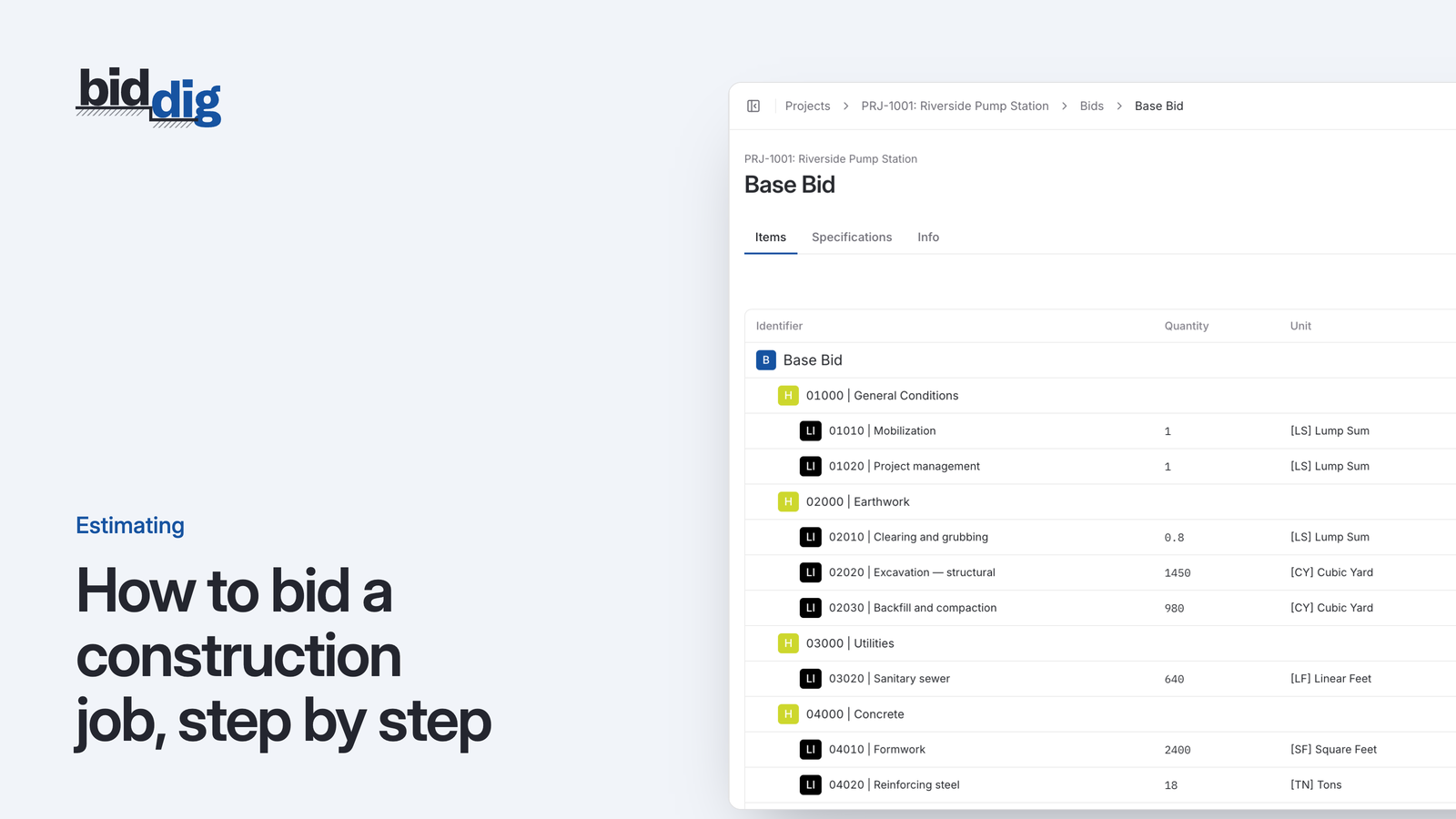
To bid a construction job, read the scope, break the work into line items with quantities, cost each line as material, labor, equipment, subcontractor and contingency, and total the direct cost. Then add tax, bond, overhead and profit, and send the price as a written proposal that states what is excluded. Do it in that order every time.
A bid that loses money was rarely underpriced on purpose. Something was left out, a rate was stale, or the markup was applied to the wrong number. A fixed order is the cheapest protection against all three.
What are the steps to bid a construction job?
The same seven steps work for a driveway and for a pump station. Only the number of lines changes.
- Read the plans, specifications and addenda, and decide what is in your scope and what is not.
- Break the job into line items, each with a quantity and a unit.
- Cost each line item as material, labor, equipment, subcontractor and contingency.
- Add up the lines to get the direct cost, and check it against similar past work.
- Add tax, bond, overhead and profit.
- Write the proposal: the price, the level of detail, the exclusions and how long the price holds.
- Keep the bid after award, because it becomes the budget for the job.
The rest of this post goes through each step.
How do you read the scope before pricing a bid?
Start with the plans, the specifications and any addenda, and write down what you are being asked to build. Then write down what you are not.
Three questions settle most of it:
- What work is clearly yours?
- What work is clearly someone else's?
- What is unclear?
The unclear items are where disputes come from. Each one needs a decision before bid day: price it, exclude it in writing, or ask. See construction proposal exclusions and clarifications for how to word them.
Walk the site if you can. Access, haul distance, existing utilities and where you can stockpile material all change the cost, and none of them are on the drawings.
How do you break a construction job into line items?
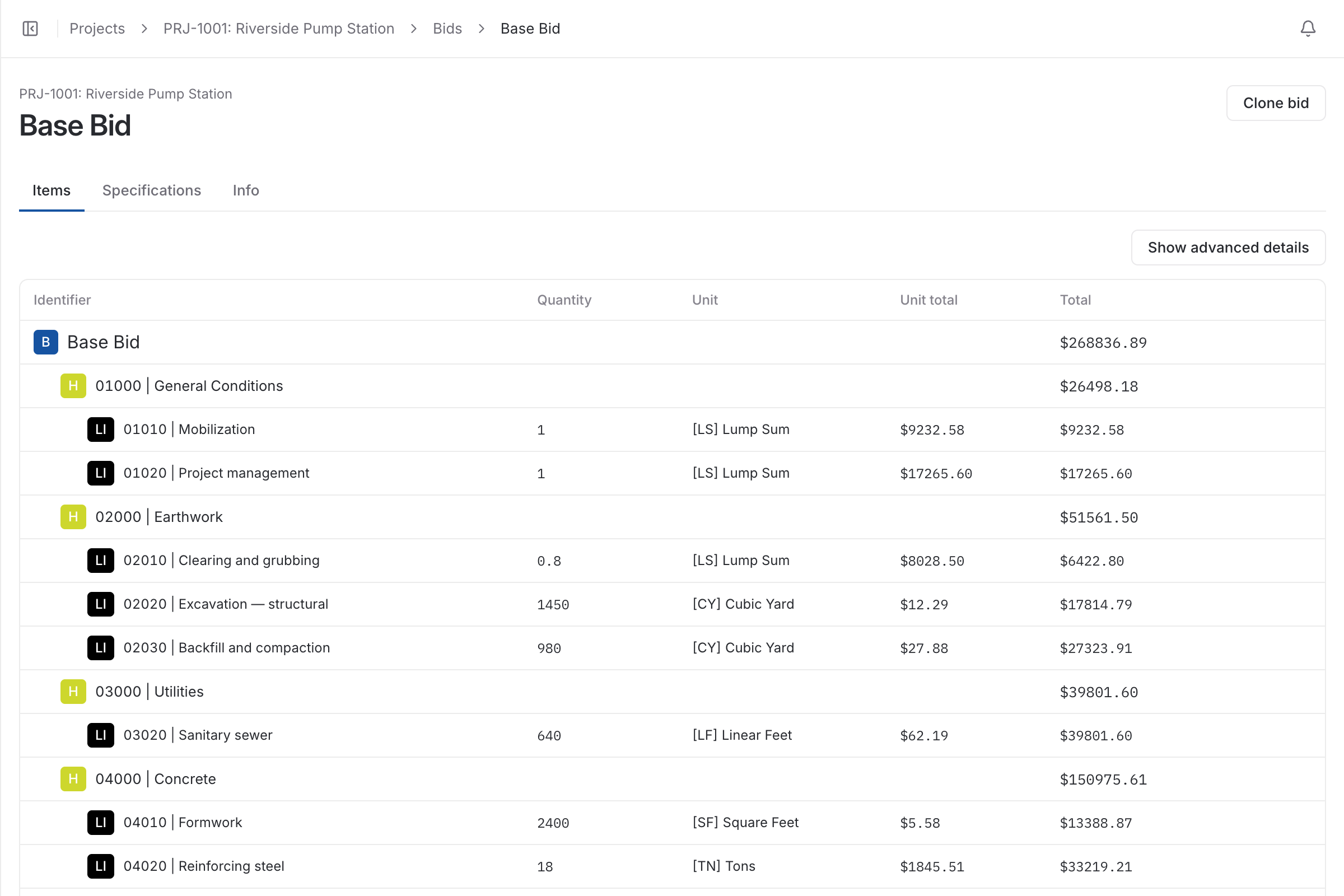
A line item is one piece of work you can measure and price: clearing, excavation, backfill, a run of pipe, a concrete pad. Group them under headers such as earthwork, utilities and concrete.
Use the same headers and line items from job to job. When the list is the same every time, you stop forgetting things, and you can compare this bid with the last one.
Give each line a quantity and a unit: cubic yards, linear feet, square feet, tons, or a lump sum where the work cannot sensibly be measured.
How do you estimate the cost of each line item?
Every line is built from the same five parts. Price them separately, because they go wrong in different ways.
| Part | What to include |
|---|---|
| Material | Quantity times current unit price, plus waste and delivery |
| Labor | Crew hours times what an hour really costs you, not just the wage |
| Equipment | Machine hours times an hourly rate, owned or rented |
| Subcontractor | The sub's quote for that piece of work |
| Contingency | An allowance for the specific risk on that line |
Labor is the easiest part to understate. The wage is not the cost. Payroll taxes, insurance and benefits sit on top of it, which is covered in how to calculate labor burden rate in construction.
Equipment is the easiest part to leave out, because an owned machine does not send an invoice. It still costs money every hour it runs. See equipment cost per hour for owned and rental equipment.
A worked example of one line item
Say you are bidding 1,000 cubic yards of trench excavation and you expect the crew to move 125 cubic yards a day. That is 1,000 / 125 = 8 days.
- Labor: 3 people x 8 hours a day x 8 days = 192 hours. At an example burdened rate of $45 an hour, 192 x $45 = $8,640.
- Equipment: one excavator for 8 x 8 = 64 hours. At an example rate of $95 an hour, 64 x $95 = $6,080.
- Material: none on this line.
- Contingency: $700 for the chance of hitting rock.
The cost of the line is $8,640 + $6,080 + $700 = $15,420, or 15,420 / 1,000 = $15.42 a cubic yard. Use your own production and your own rates. These figures are only there to show the arithmetic.
Total the direct cost and check it
Add up every line. This number is your direct cost: what the job will cost you to build before the company's running costs and before profit.
Stop and check it. Does the cost per unit on the big lines look like the last similar job? If excavation came out at half what it cost you last time, find out why before you go further.
How do you add overhead, profit, tax and bond to a bid?
Now the markup. Four things are usually added, and they are not the same thing:
- Tax on the parts of the job that are taxable where you work.
- Bond, if the job requires one.
- Overhead, the cost of running the company that no single job pays for directly: the office, insurance, estimating, your own salary.
- Profit, what is left for the business after everything else is paid.
Overhead should be a rate worked out from your own annual figures, not a habit. That is explained with examples in how to calculate overhead and profit in a construction bid.
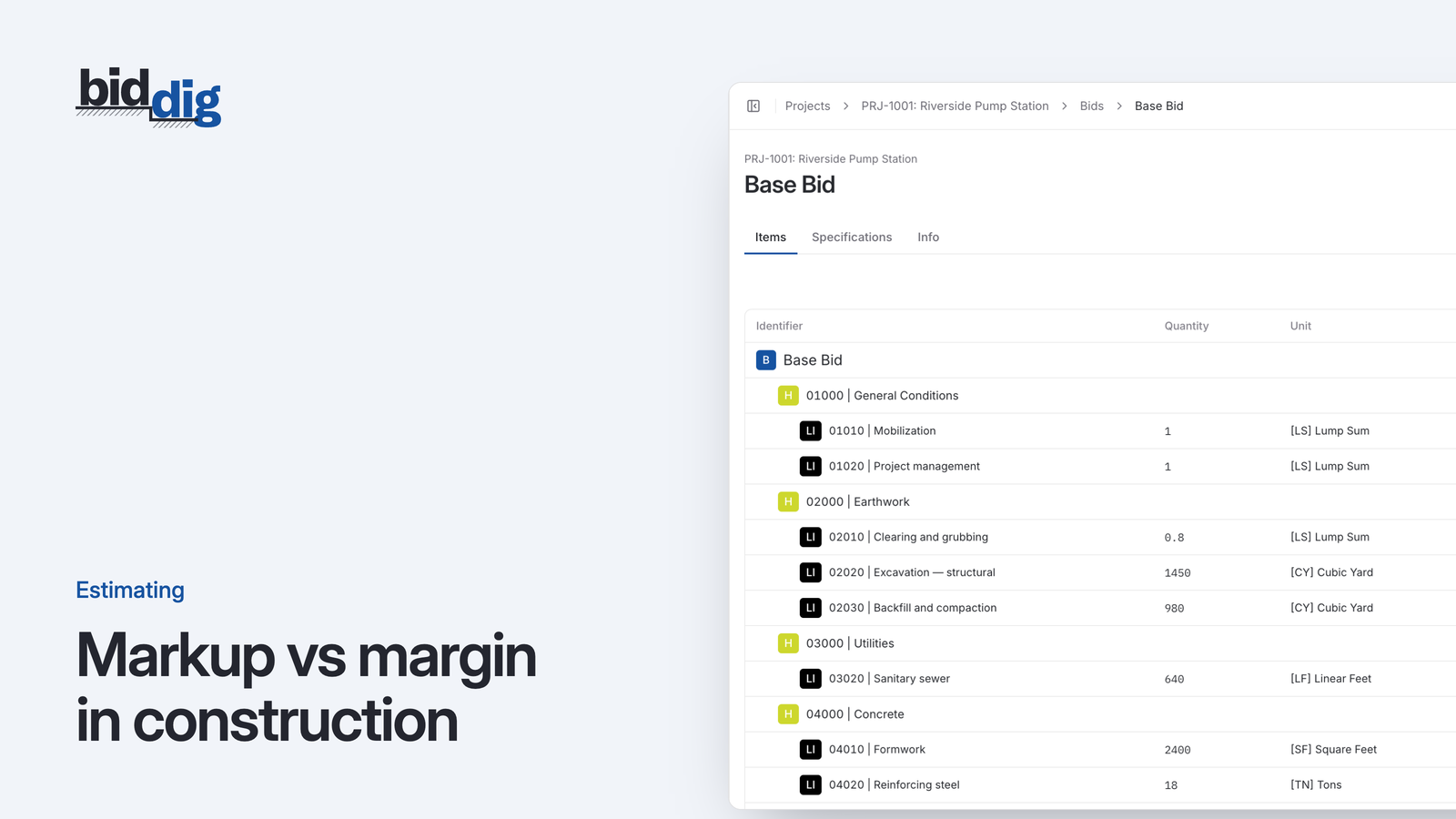
The mistake to avoid is confusing markup with margin. Add a 20% markup to a $100,000 cost and the price is $120,000. The $20,000 is 20,000 / 120,000 = 16.7% of the price, not 20%. Markup vs margin in construction has the formulas and a conversion table.
Whatever rates you use, apply them in the same order on every bid, so that one bid can be compared with the next.
What goes in a construction bid proposal?
The estimate is yours. The proposal is what the customer sees, and it rarely needs to show everything.
Decide how much detail to give: one lump sum, unit prices, or a breakdown by material, labor and equipment. Lump sum vs unit price bids covers which to use. Then state:
- what is included, in words the customer will recognize from the drawings;
- what is excluded;
- how long the price is good for;
- how changes will be priced.
Send it, and record which version went out.
Keep the bid after you win
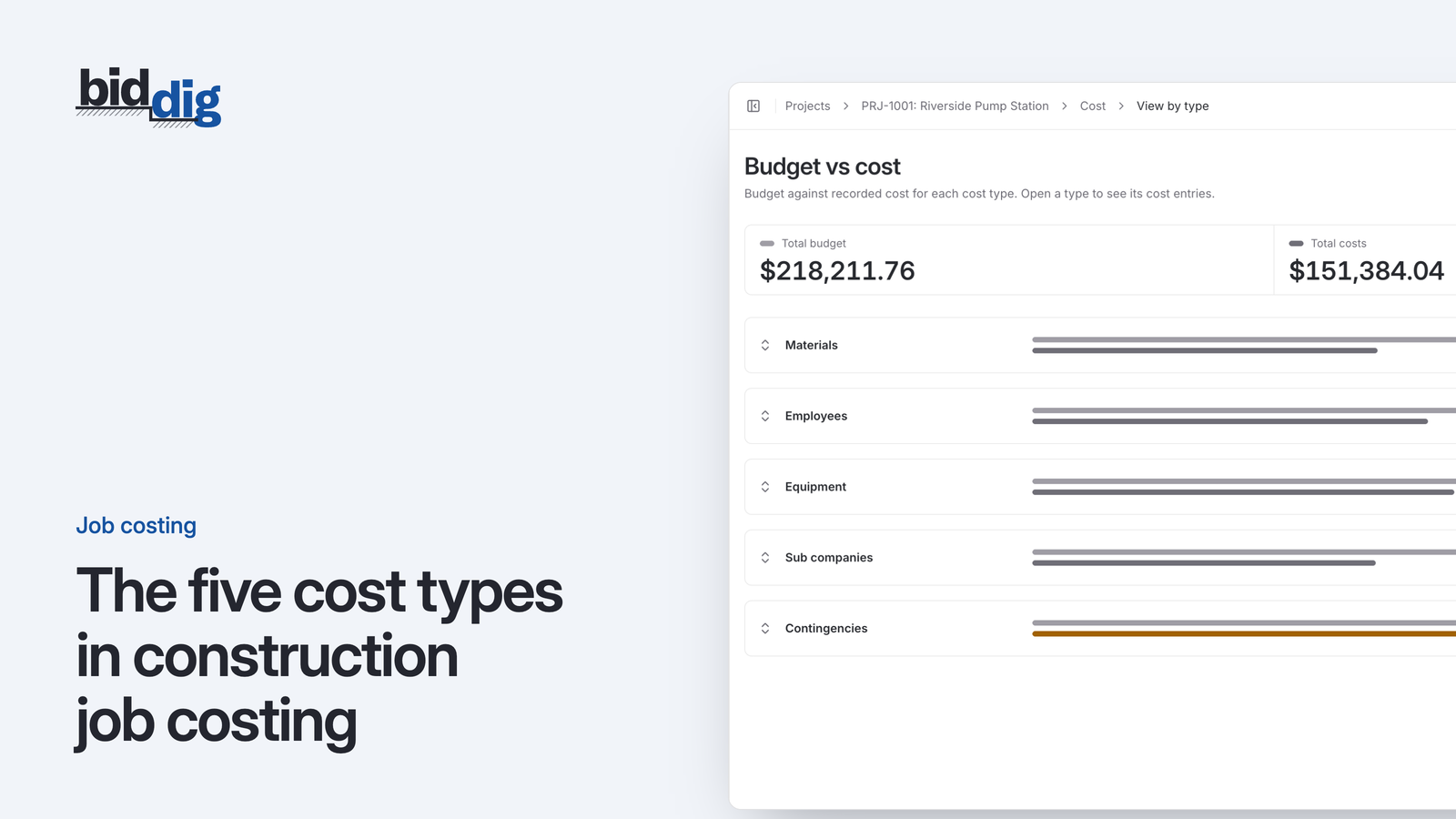
The bid you won is the best budget you will ever have for that job. Each line item is a number you can hold the work to. If the estimate is filed away at award, you lose the only way to tell, during the job, whether it is going to plan. How to track job costs in construction picks up from here.
How BidDig handles it
In BidDig a bid is built from your own catalog of bid items, employee classifications, equipment, materials and subcontractors. Each line item is costed as material, labor, equipment, subcontractor and contingency, and tax, bond, overhead and profit are calculated from your default rates. The bid is sent as a PDF proposal in one of eight styles, and when it is awarded its line items become the budget for job costing. See estimating and bidding. For how the pieces fit together, see construction estimating software.