The five cost types in construction job costing
Material, labor, equipment, subcontractor and miscellaneous. What belongs in each, where costs commonly get put in the wrong one, and why it matters for the next bid.
By the BidDig team, , 5 min read
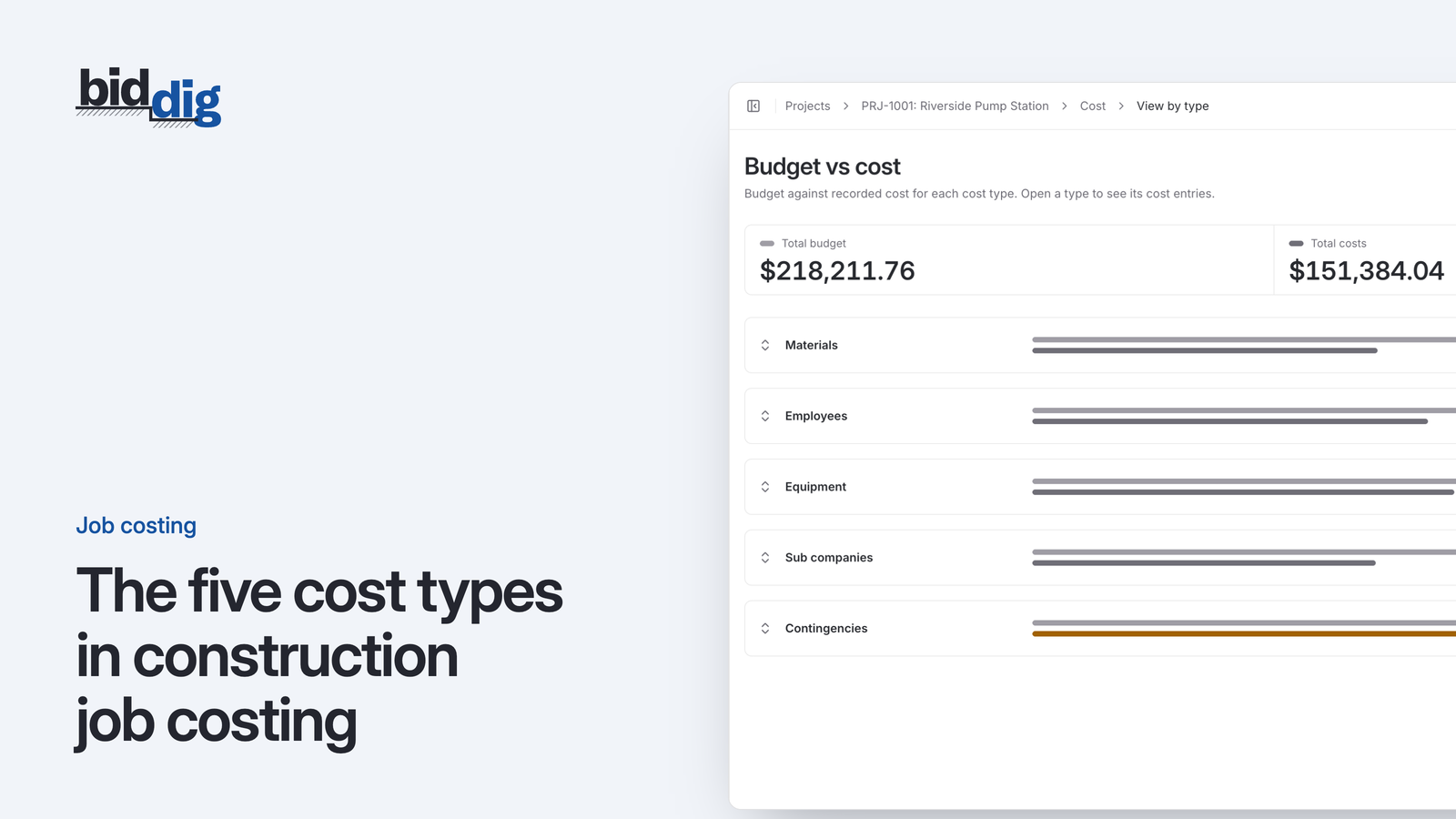
The five cost types in construction job costing are material, labor, equipment, subcontractor, and miscellaneous or contingency. Each line item in a bid is built from these, and actual costs are recorded under the same types, so that an overrun can be traced to the assumption behind it: a quantity, a price, an hour count or a rate.
Here is what happens when the types get mixed up. A job finishes on budget overall, but the report says material ran well over and subcontractor cost came in well under. The estimator starts raising material prices on the next bid.
Then someone looks closer. A subcontractor's bill was entered as material. Nothing was actually over. The estimate was right, the coding was wrong, and the next bid nearly got more expensive for no reason.
Cost types are simple, and most people could name them without thinking. The mistakes happen at the edges, with costs that could reasonably go in two places. This post sets out the five types and where those edges are.
Why are job costs split by cost type?
Each line item in a bid is built up from different kinds of cost, because each kind is estimated differently:
- Material is a quantity times a unit price.
- Labor is hours times a rate.
- Equipment is hours times an hourly cost.
- A subcontractor is usually a quoted price.
- Contingency is an allowance for what you cannot pin down.
When actual costs are recorded under the same types, you can check each part of the estimate separately. If labor is over, the hours or the rate were wrong. If material is over, the quantity or the price was. Mix the types up and you no longer know which assumption to fix.
What are the five cost types and what goes in each?
| Cost type | What belongs in it |
|---|---|
| Material | Things you buy that stay in the job or are used up building it |
| Labor | Hours worked by your own employees |
| Equipment | Hours of machines you own or rent |
| Subcontractor | Work done by another company under its own price |
| Miscellaneous or contingency | Job costs that fit none of the above, and the allowance for unknowns |
Material. Pipe, concrete, aggregate, rebar, lumber, fittings. Include what it costs to get the material to the site if the supplier charges for delivery, since that is part of what the material cost you. Estimated as quantity times unit price, with the unit stated (CY, LF, SF, TN and so on).
Labor. Your own people, by the hour. The rate should reflect what an hour of that classification costs the company, not only the wage on the paycheck. Whatever you include in the rate when bidding, use the same rate when costing, or the comparison means nothing.
Equipment. Machine hours, whether the machine is owned or rented. Owned equipment still has an hourly cost: the machine wears out, burns fuel and needs repairs whether or not a bill arrives that week. Leave owned equipment at zero and every job looks more profitable than it was.
Subcontractor. Work you pay another company to perform, normally for a quoted lump sum or unit price. Their labor, material and equipment are all inside their price. You do not split it up.
Miscellaneous or contingency. In the bid, contingency is money set aside for risk on a line. During the job, real costs turn up that are none of the other four: a permit fee, a testing charge, a dump fee. These go to miscellaneous. Keep this category small. If it grows large, costs that belong elsewhere are being parked in it.
Common job cost coding mistakes
These are the places where costs most often land in the wrong type.
Subcontractor bills entered as material. The bill lists pipe and fittings, so it looks like material. If the company that sent it also installed the work, it is a subcontractor cost.
Rented equipment with an operator. A crane or pump truck that arrives with its own operator, for a single price, is closer to a subcontractor than to equipment. Rented without an operator and run by your people, it is equipment, and your operator's hours are labor. Decide which way you treat it and do the same in the bid.
Operator hours hidden in the equipment rate. If the excavator's hourly cost in your bid includes the operator, do not also record the operator's hours as labor on that line, or the cost is counted twice. If the rate is machine only, the operator goes on the timesheet as labor.
Fuel and small tools. Fuel for a machine is part of that machine's operating cost. If your equipment hourly cost already includes fuel, a fuel bill coded to the job as material counts it a second time.
Material supplied to a subcontractor. If you buy the pipe and a subcontractor installs it, the pipe is your material and the installation is the subcontractor cost. Bid it that way and cost it that way.
The owner's own hours. An owner who runs a machine for two days is labor on that job. Left out, the line looks cheaper than it is, and the next bid assumes hours that are free.
How to decide which cost type a cost belongs in
For nearly every edge case there is more than one defensible answer. The rule that settles them is this: code the cost the same way you bid it.
If the bid carried the pump truck as a subcontractor, cost it as a subcontractor. If the bid's equipment rate included fuel, do not cost fuel separately. Consistency between the bid and the costs matters more than which convention you pick.
Example: what one miscoded bill does to the report
Say a line was bid with $12,000 for a subcontractor and $8,000 of material, and both came in exactly on estimate. Then the subcontractor's $12,000 bill is coded to material.
| Cost type | Budget | Actual as coded | Shown as |
|---|---|---|---|
| Material | $8,000 | $20,000 | $12,000 over |
| Subcontractor | $12,000 | $0 | $12,000 under |
| Line total | $20,000 | $20,000 | On budget |
Material shows 12,000 divided by 8,000 = 150 percent over. Nothing went wrong on the job, and the report says two things did.
Write your conventions down. For what a complete line looks like, see what belongs in a bid line item.
How BidDig handles cost types
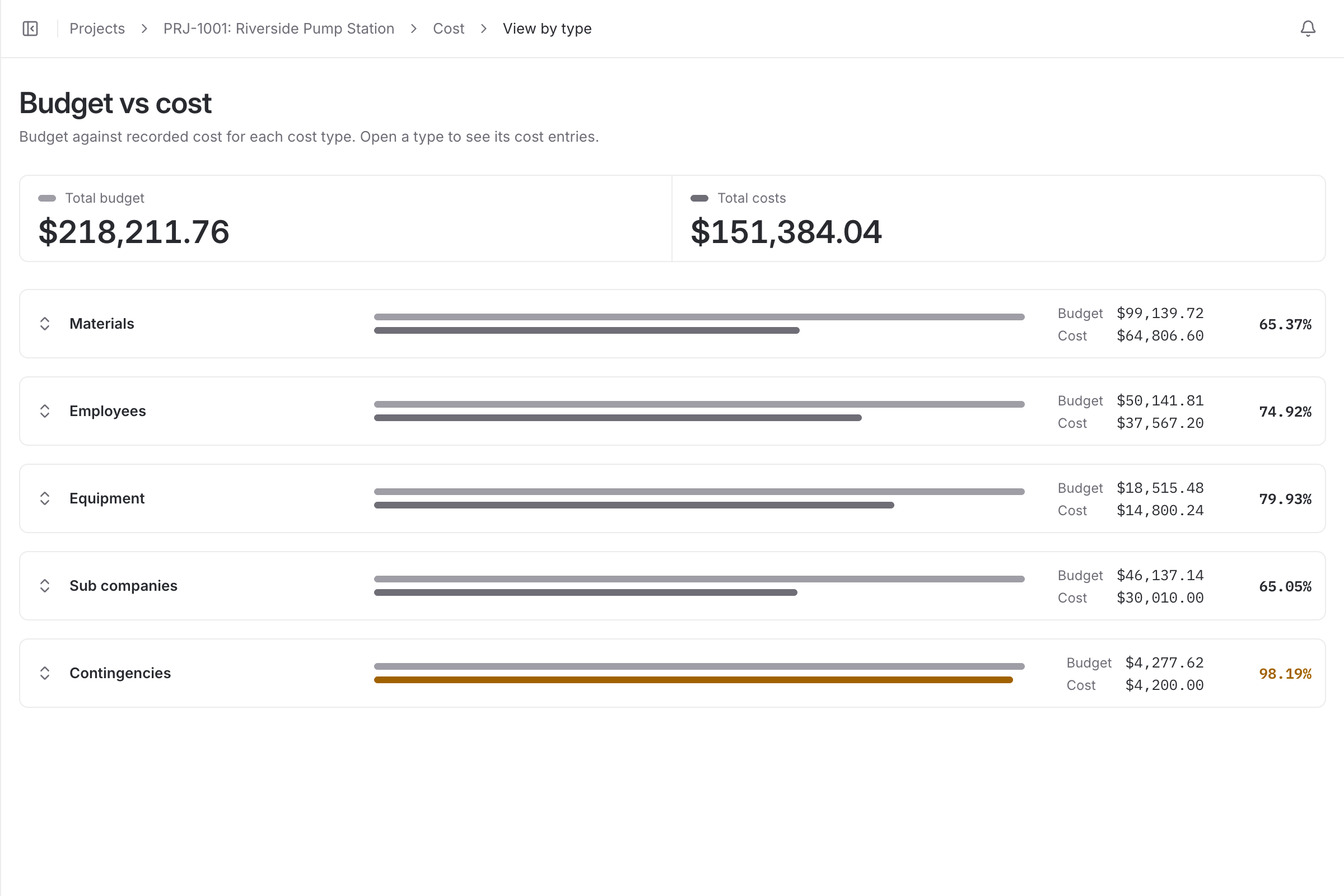
BidDig uses the same cost types on both sides. In a bid, each line item is costed as material, labor, equipment, subcontractor and contingency. Once the bid is awarded, costs are recorded against the same line items as material, labor, equipment, subcontractor and miscellaneous, and budget vs actual is shown by cost type and by line item. Equipment in the catalog is marked owned or rental and carries an hourly operating cost. See job costing, and read budget vs actual by cost type or by line item. For how the pieces fit together, see construction job costing software. For the basics, read how to track job costs in construction.