How to price a construction change order
A change agreed with a handshake on site becomes an argument at the end of the job. Pricing each change the way you priced the bid, and getting an answer before the work starts, avoids most of it.
By the BidDig team, , 5 min read
To price a construction change order, write the changed scope as line items, cost each line as material, labor, equipment and subcontractor at the rates used in the bid, then add overhead and profit at the same percentages as the original bid, plus tax and bond where they apply. Send the price and get approval before the work starts.
Here is how it usually goes instead. The owner's representative walks the site and asks for 60 more feet of pipe and an extra manhole. The superintendent says it can be done. The crew is there, the excavator is there, so the work goes in that week.
Two months later the final bill includes a figure for "extras". The owner remembers a small favor. You remember a day and a half of crew time, a manhole and a truck of bedding stone. There is no agreed price, no signature and no shared record of what was asked for. The conversation that follows is about who remembers what.
Extra work is normal. The trouble comes from doing it before anyone has agreed what it costs.
Why verbal change orders go wrong
A verbal change has three weaknesses.
The scope is vague. "Add a manhole" does not say how deep, what kind, who supplies it, or whether paving restoration is included. Each side fills the gaps in its own favor.
The price comes afterwards. Once the work is in the ground, the customer has what they wanted. Your number now arrives as a surprise, and the only bargaining position left is theirs.
The cost gets lost in the job. If the extra work is not tracked separately, its hours and material land on the original line items. Those lines now look over budget, and you cannot show what the extra work cost because it is mixed in with the base contract.
The third point is easy to miss. Unpriced changes do not only risk non-payment. They damage your job cost records, because the original budget is now being compared against costs for work it never included.
How do you calculate the price of a change order?
The formula is short:
Change order price = estimated cost of the change + overhead and profit + tax and bond where they apply
A change order is a small bid. It deserves the same method as the original, for two reasons. The number is more likely to be right, and it is easier to defend, because the customer can see it was built the same way as the price they already accepted.
That means:
- Write the scope as line items. Quantity, unit and description, exactly as in the bid.
- Cost each line by cost type. Material, labor, equipment and subcontractor, using the same rates and prices as the bid unless something has really changed.
- Apply the same markup. Overhead, profit, and tax and bond where they apply, at the rates the original bid used.
- State what is not included. If restoration, testing or traffic control is excluded, say so.
Change order pricing example
Say the request is 60 LF of additional pipe and one manhole, and you cost it like this:
| Cost type | Basis | Amount |
|---|---|---|
| Material | Pipe, manhole and bedding | $3,200 |
| Labor | 32 hours at $45 | $1,440 |
| Equipment | 16 hours at $85 | $1,360 |
| Estimated cost | $6,000 |
Say overhead and profit on the original bid came to 20 percent of cost between them. On $6,000 that is 6,000 x 20% = $1,200, so the change is priced at 6,000 + 1,200 = $7,200 before any tax or bond.
Compare that with what happens on site without it. Someone guesses "about five grand" from memory. That guess is below your $6,000 cost before any markup is added.
How much markup goes on a change order?
Start with the rates the original bid used. Before you send the price, read the contract. If it states the overhead and profit allowed on changes, that figure governs, and you should know it when you bid the job, not when the first change arrives.
How to price a deduct change order
A change can also be a deduction. If the customer removes work, price what comes out using the same lines and rates it went in at. The method is the same and the sign is different.
How to get a change order approved before the work starts
A priced change needs a decision, and each change needs its own.
Send it in writing as a proposal, with the scope and the price, and ask for approval before the work starts. Keep one change per document where you can. When five changes are bundled into one number, the customer who objects to one of them holds up all five.
Each change should end in one of two states: approved or rejected. Both are useful. An approved change is added revenue with a record behind it. A rejected change is a clear instruction not to do the work, also with a record behind it.
The state to avoid is "pending" while the crew is already building it.
What if the extra work cannot wait?
Sometimes the work has to start first, such as an unsafe condition or a crew that would otherwise stand idle. In that case:
- Get the instruction in writing, even a short email, before starting.
- Say in your reply that a price will follow and that the work is extra to the contract.
- Record the hours, equipment and material for that work separately from the first hour.
- Send the price within days, while everyone still remembers the request.
How to track change order costs separately from the original budget
Once a change is approved, treat it as its own piece of the job. It has its own budget (the estimated cost of the change, before markup) and should collect its own actual costs.
This keeps two comparisons honest. The original line items are measured only against the work they were bid for. The change is measured against its own estimate, so you learn whether you price changes well, which is worth knowing because changes are often priced in a hurry.
It also gives you a simple list for the end of the job: every change, its price, and whether it was approved. That list is what you bill from. It replaces the argument about what was said in the trench in March.
For a reminder of what a well-built line contains, see what belongs in a bid line item.
How BidDig handles change orders
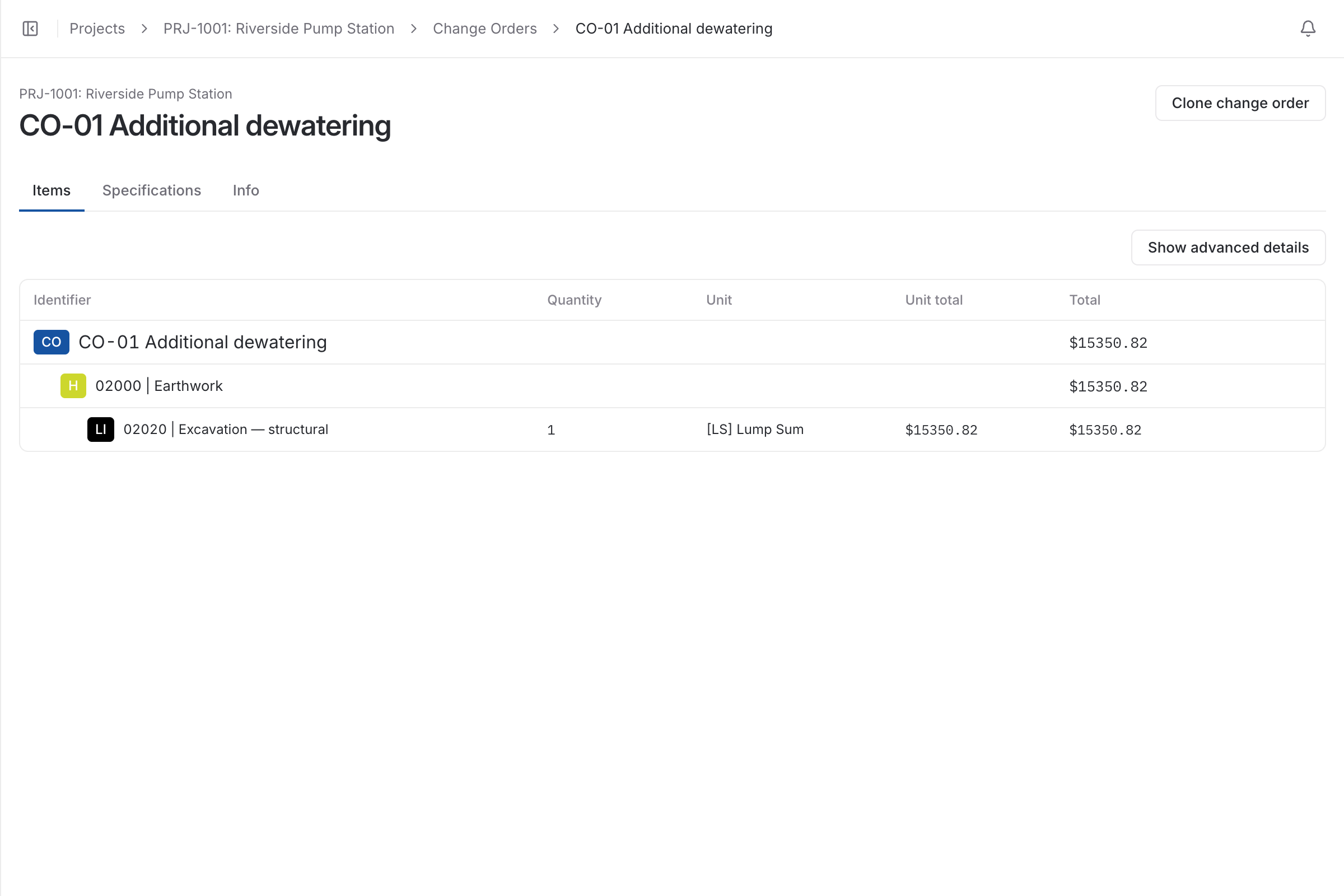
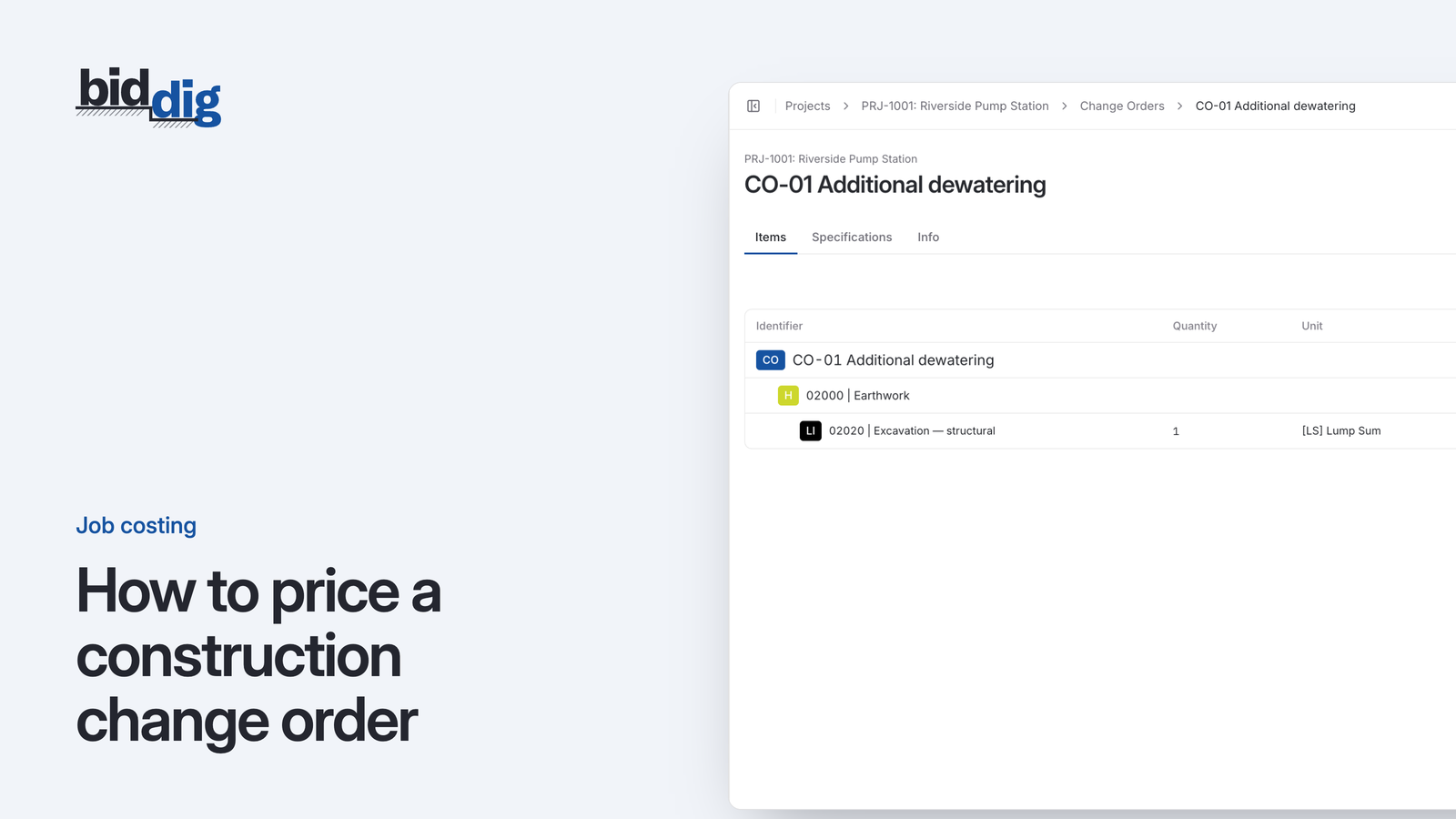
In BidDig a change order is built like a bid, from the same catalog of line items, materials, labor classifications, equipment and subcontractors, with the same markup. A change order can only be added to a project that has an awarded bid. Each one is awarded or rejected on its own, and it can be sent to the customer as a proposal. See change orders for the details, and construction job costing explained for how the budget and actual costs fit together. For how the pieces fit together, see construction bidding software.