Equipment cost per hour: owned vs rental equipment in a bid
A machine you own and a machine you rent cost you money in different ways. Here is how to work out an hourly rate for each before you put it in a bid.
By the BidDig team, , 6 min read
Equipment cost per hour for an owned machine is its yearly ownership cost (loss of value, insurance, storage, interest) divided by the hours it works in a year, plus its running cost per hour (fuel, maintenance, wear parts). For a rented machine it is the rental, delivery and fuel for the period divided by the hours it will actually work.
How do you calculate equipment cost per hour for an owned machine?
The formula:
- Hourly cost = (yearly ownership cost ÷ hours worked in a year) + running cost per hour
Ownership cost is what the machine costs you whether it works or sits: the value it loses each year, insurance, registration, storage and any loan interest. Running cost is what it costs only when it works: fuel, maintenance, repairs and wear parts.
Here is a worked example. Every figure is an example to replace with your own.
Say you buy an excavator for $180,000, expect to sell it for $60,000 after six years, and expect to work it 1,200 hours a year. Insurance, registration and storage come to $6,000 a year. It burns 5 gallons an hour at $4.00 a gallon. Maintenance, repairs and wear parts average $15.00 for every hour worked.
| Cost | Calculation | Per hour |
|---|---|---|
| Loss of value | ($180,000 − $60,000) ÷ 6 years = $20,000 a year, ÷ 1,200 hours | $16.67 |
| Insurance, registration, storage | $6,000 ÷ 1,200 hours | $5.00 |
| Fuel | 5 gallons × $4.00 | $20.00 |
| Maintenance, repairs, wear parts | Example average | $15.00 |
| Hourly cost | $56.67 |
- Ownership per hour: 16.67 + 5.00 = $21.67
- Running per hour: 20.00 + 15.00 = $35.00
- Total: 21.67 + 35.00 = $56.67
Three notes on the example:
- The operator is not in this number. Price the operator as labor, at the full cost of the hour. See how to calculate labor burden rate.
- If the machine is financed, add the yearly interest to the ownership side.
- Use your own records for fuel and repairs where you have them.
How do annual hours change the hourly rate?
The ownership part of the rate depends entirely on how many hours you divide by. In the example, ownership costs 20,000 + 6,000 = $26,000 a year.
| Hours worked in a year | Ownership per hour | Running per hour | Total per hour |
|---|---|---|---|
| 1,200 | $26,000 ÷ 1,200 = $21.67 | $35.00 | $56.67 |
| 800 | $26,000 ÷ 800 = $32.50 | $35.00 | $67.50 |
Same machine, same costs, and the rate rises by 67.50 − 56.67 = $10.83 an hour because it worked 400 fewer hours.
If you priced every job at $56.67 and the machine only worked 800 hours, you under-recovered 10.83 × 800 = $8,664 for the year on that one machine.
So be honest about hours. Use last year's actual hours from the meter or your timesheets, not the hours you hope for. This is where recording machine hours on the job pays back at bid time. The post on how to track equipment hours as a job cost covers that side: what to record once the job is awarded, and how to compare it with what the bid allowed.
How do you price rental equipment in a bid?
Start from the rental quote and add everything the quote leaves out. Then divide by the hours the machine will work, not the hours in the rental period.
Say you rent the same class of excavator for one month at $9,000. Delivery and pickup total $1,200. You expect 120 working hours in that month, burning $20.00 of fuel an hour.
- Rental: $9,000
- Delivery and pickup: $1,200
- Fuel: 120 × $20.00 = $2,400
- Total: 9,000 + 1,200 + 2,400 = $12,600
- Per working hour: $12,600 ÷ 120 = $105.00
Two things to watch.
Price the rental period, not just the productive hours. The invoice does not stop for weather or for waiting on another trade. If the machine works 90 hours instead of 120, fuel falls to 90 × $20.00 = $1,800, the total is 9,000 + 1,200 + 1,800 = $12,000, and the hour costs $12,000 ÷ 90 = $133.33.
Match the period to the schedule. A job that needs the machine for five weeks is two monthly periods or one month plus a week, and the estimate should say which.
Rent vs own equipment: which is cheaper per hour?
It depends on how many hours a year the machine will work for you. Owning is cheaper per hour only above a certain number of hours.
Using the two examples above, the rented hour costs $105.00 and the owned hour costs $35.00 to run plus a share of $26,000 a year. The break-even is where that share fills the gap:
- Gap between rental and running cost: 105.00 − 35.00 = $70.00 an hour
- Break-even hours: $26,000 ÷ $70.00 = about 371 hours a year
Check: at 371 hours, ownership is 26,000 ÷ 371 = $70.08 an hour, and 70.08 + 35.00 = $105.08.
In this example, a machine that works fewer than about 371 hours a year costs more per hour to own than to rent. One that works 1,200 hours costs about half as much.
Treat that as a way of thinking, not a rule. The rental figure came from one month at 120 hours, and both sides move with your own numbers. Per-hour cost is also not the whole decision: owning ties up cash and leaves you with a machine to keep busy, while renting leaves you dependent on what is available when you need it.
For a machine you need for one job a year, rental is often the cheaper and safer choice. For one that works most weeks, the arithmetic usually points the other way.
Is rental equipment taxed differently from owned equipment in a bid?
Often, yes, and it is a reason to keep the two apart in an estimate.
A rental is a purchase made for the job. The rental house will often charge sales tax on the invoice, in the same way a supplier does on material, so the tax is a job cost that needs to be in the bid.
An owned machine is different. Any tax on the purchase was paid when you bought it, and it is already inside the ownership cost you are recovering through the hourly rate. Adding tax to the hourly rate again would count it twice.
That is why a careful estimate keeps owned and rental equipment as separate kinds of cost and does not run them through the same tax calculation. The rules differ by state and by type of contract, so confirm with your accountant how equipment rental is taxed where you work.
How BidDig handles equipment in a bid
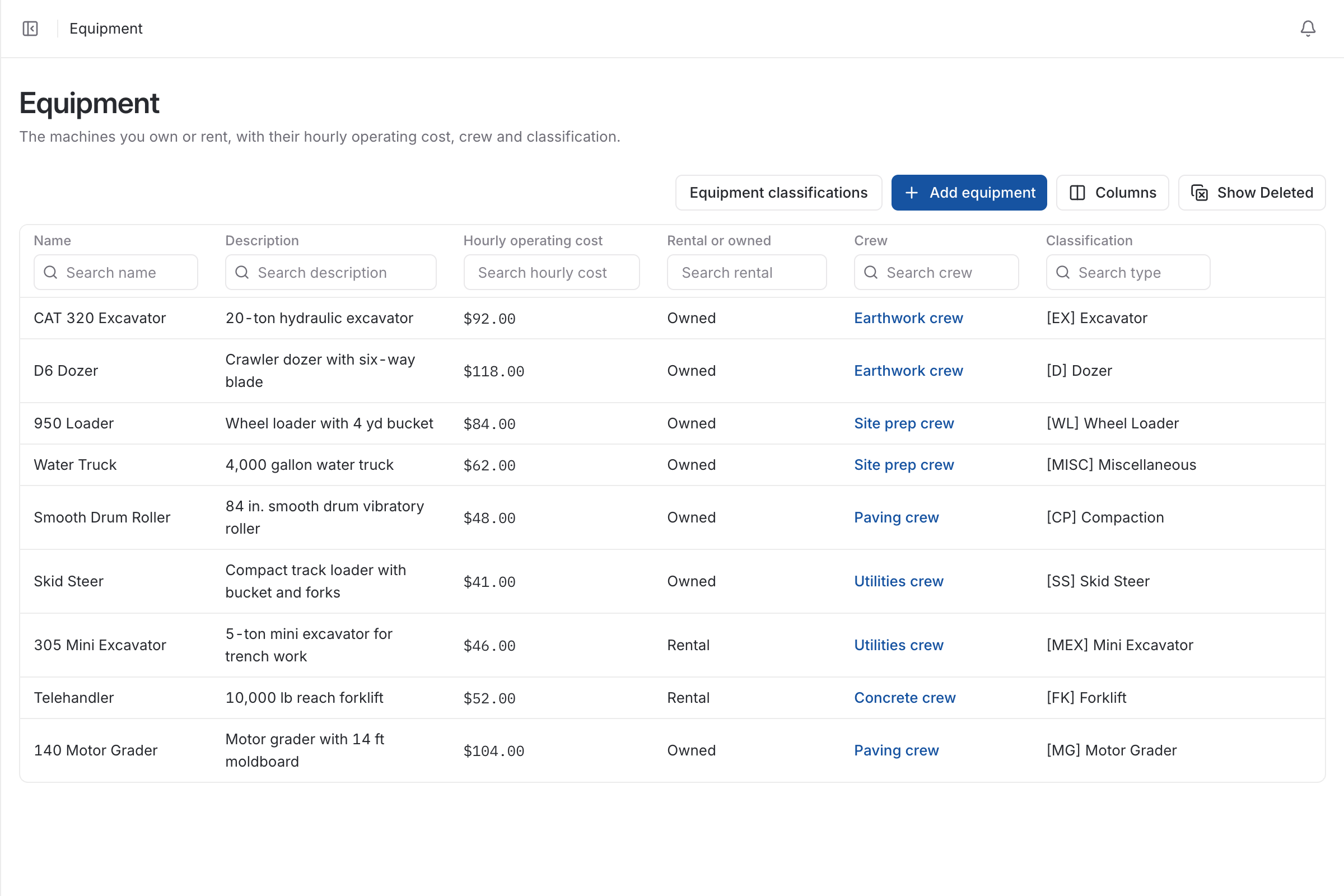
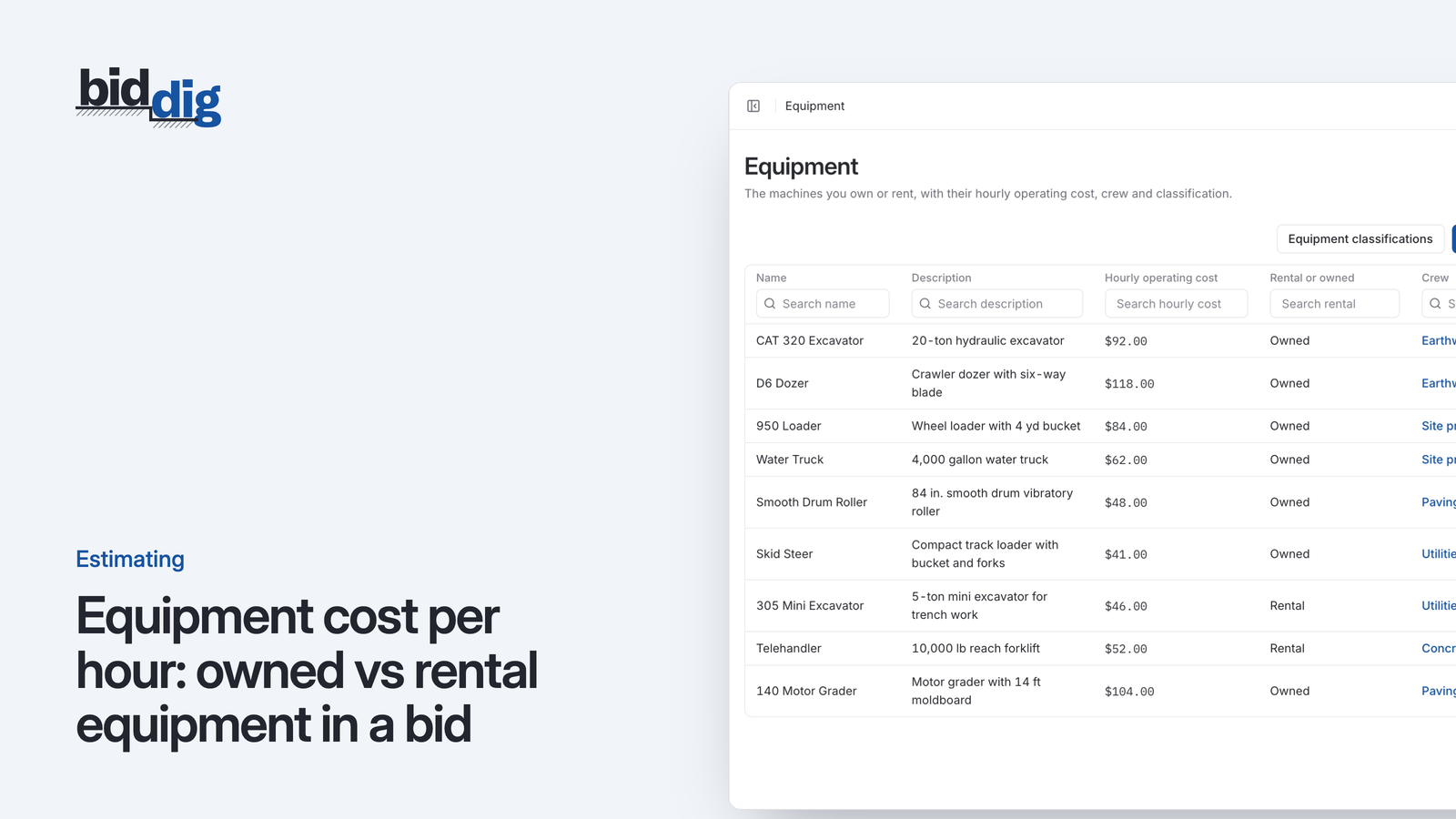
In BidDig, each piece of equipment in your catalog is marked as owned or rental and carries an hourly operating cost. When you add it to a line item, that rate is what the bid uses, so every estimator prices the machine the same way. Owned and rental equipment are treated differently when the bid calculates tax and bond.
See the estimating and bidding page for how a bid is built, and what belongs in a bid line item for where equipment sits beside the other costs. For how the pieces fit together, see excavation estimating software. If you are starting from scratch, read how to bid a construction job, step by step.