Construction proposal exclusions and clarifications
The price says what the job costs. The exclusions and qualifications say what the price covers. Vague ones are the usual start of an argument about who pays for extra work.
By the BidDig team, , 5 min read
Exclusions name work that is not in the price. Clarifications, also called qualifications or assumptions, state the conditions the price depends on, such as the drawings it is based on or the number of mobilizations. A proposal needs both, written specifically enough to be tested on site, so that you and the customer are pricing and buying the same job.
Here is what happens without them. Halfway through the job the crew hits rock. You call the customer and say it is extra. The customer says the price was for the excavation, and rock is part of excavating. You both go back to the proposal, and it says "Excavation as required" and nothing else.
At that point the proposal is not helping either of you. The scope was clear in your head when you priced it, but the only version that counts is the one on paper.
What is the difference between an exclusion and a clarification?
An exclusion names work that is not in the price. "Rock excavation is excluded" means that if rock turns up, removing it is additional work.
A qualification (also called a clarification or an assumption) states a condition the price depends on. "Price is based on one mobilization" does not exclude anything. It says that if the job is stopped and restarted, the price changes.
An inclusion is the other side: a plain statement of what the price does cover. A short scope description heads off many disputes before the exclusions are ever needed.
| Term | What it says | Example |
|---|---|---|
| Inclusion | What the price covers | "Includes up to 200 cubic yards of imported fill" |
| Exclusion | What the price does not cover | "Rock excavation is excluded" |
| Clarification or qualification | What the price assumes | "Price is based on one mobilization" |
How to write proposal exclusions that hold up
Weak exclusions tend to fail in the same few ways. They are vague, they contradict the drawings without saying so, or they are buried where nobody reads them.
- Be specific. "Unforeseen conditions excluded" invites the question of what a careful contractor should have foreseen. "Removal of rock that cannot be excavated with the specified machine is excluded" can be tested on site.
- Refer to the documents. State the drawings and their dates, the specification sections and the addenda your price is based on. If the documents change later, you have a baseline.
- Give a quantity or a limit where you can. "Includes up to 200 cubic yards of imported fill" is stronger than "fill as needed".
- Say what happens next. If excluded work is needed, say it will be priced as a change order before the work is done, or give a unit price for it.
- Write for a reader who was not at the meeting. The person approving payment in six months may not be the person you walked the site with.
- Do not exclude what the bid documents require. If the bid form says include permits, an exclusion for permits may make your bid non-responsive or simply be ignored.
One caution: this post describes common estimating practice, not legal advice. How exclusions interact with a signed contract depends on the contract and on your state, so have your standard wording reviewed by a construction attorney once.
Example exclusions and clarifications for sitework
These are examples to adapt, not a list to paste in whole. Use the ones that match the job.
Sitework exclusions
- Rock excavation, and removal of boulders larger than a stated size.
- Handling, hauling or disposal of contaminated or hazardous material.
- Dewatering beyond pumping normal surface water from the excavation.
- Removal and replacement of unsuitable soil below the design subgrade.
- Relocation of existing utilities not shown on the drawings.
- Permits, fees, bonds, testing and inspection.
- Construction staking and surveying.
Sitework clarifications
- Price is based on drawings C1 to C6 dated (date) and addendum 1.
- Price is based on one mobilization. Additional mobilizations are priced per trip.
- Excess soil is to be placed on site in an area provided by the owner.
- Erosion control is installed once, with maintenance for the period stated.
Example exclusions and clarifications for general contractors
General construction exclusions
- Work on existing conditions hidden behind finishes, such as rot, damaged framing or wiring that does not meet code.
- Asbestos, lead paint and mold testing or removal.
- Design, engineering and drawings unless listed in the scope.
- Utility company connection charges and impact fees.
General construction clarifications
- Price is based on work during normal working hours, Monday to Friday.
- Allowances are stated as amounts. Selections above the allowance are added to the price.
- The owner provides water, power and a place for a dumpster.
- Price is valid for 30 days from the date of the proposal.
That last one deserves a line on every proposal you send. A price with no end date can be accepted months later, after your costs have moved. See keeping material prices current between bids.
How to build a standard exclusions list
Writing exclusions from memory on bid day is how the important one gets missed. Keep a master list instead:
- Collect the wording from your last several proposals, and from every dispute you remember.
- Group it by type of work.
- Rewrite each item once, carefully, so it is specific.
- For each bid, select the items that apply and add anything unique to the job.
- After each job, add a line for whatever caused an argument.
Standard wording has a second benefit. When the same sentence appears on every proposal, your project managers and foremen learn what it means and can spot excluded work in the field before it is done for free.
Keep the list short enough to be read. A dozen clear lines that fit the job do more than three pages of fine print.
Exclusions also set up the change order. When excluded work appears, the proposal should let you point to the line, price the work and get approval before starting. See pricing change orders before the work.
How BidDig handles exclusions and qualifications
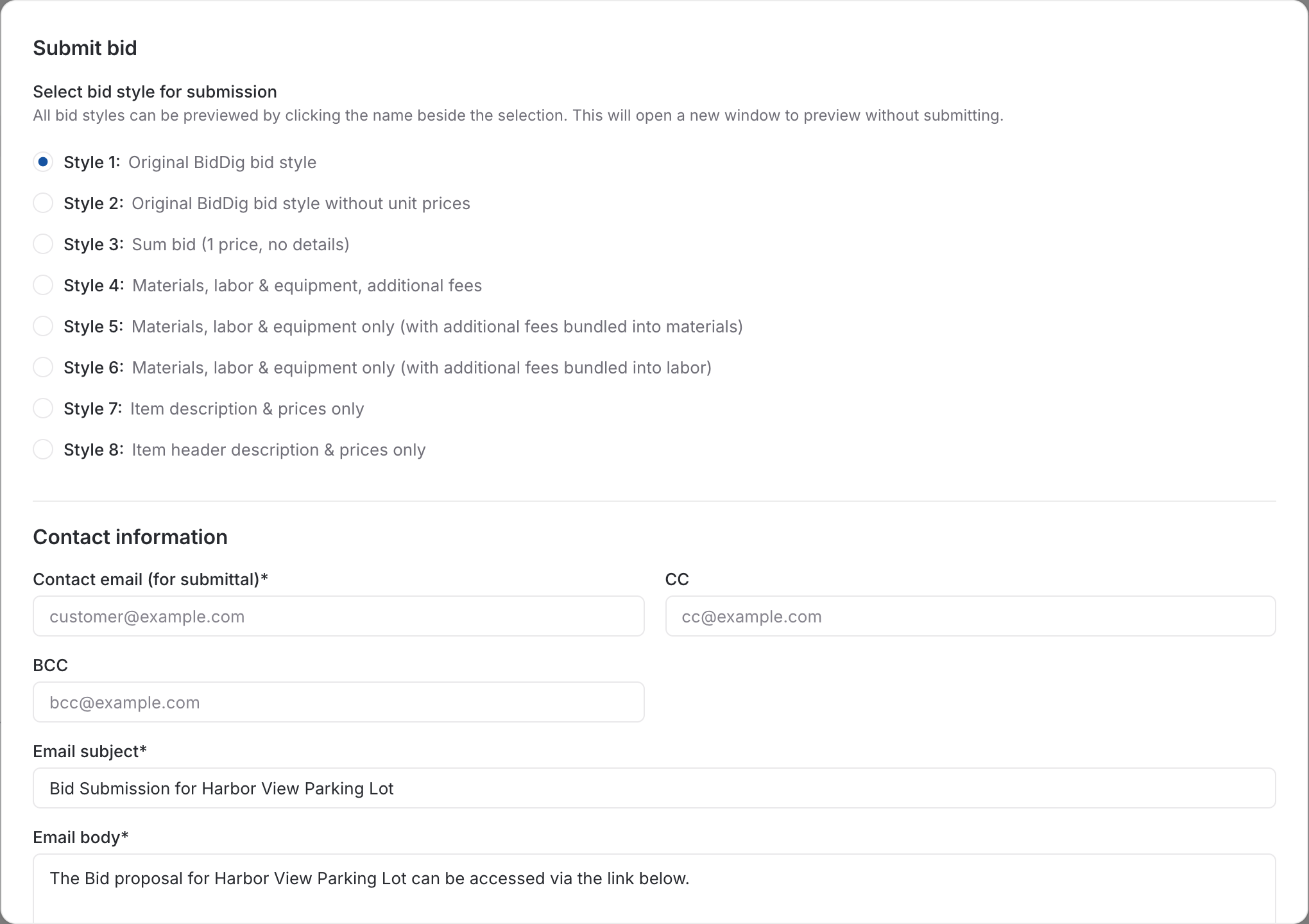
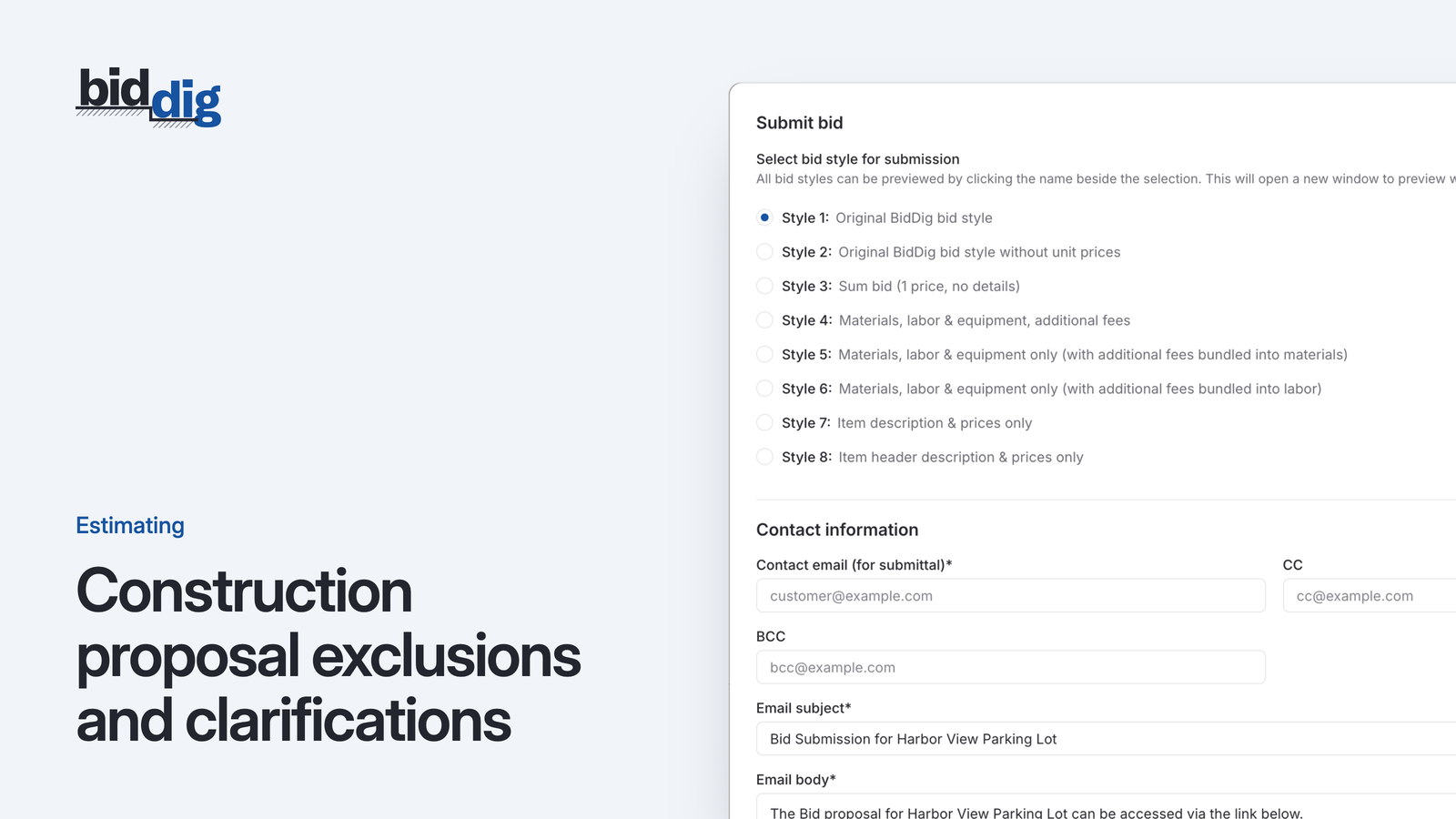
In BidDig, exclusions, qualifications and acceptance text are kept as reusable wording that can be added to a bid, so the same sentences go out each time and you are not retyping them on bid day. They are part of the proposal, which is sent as a PDF with your company logo in one of eight styles and emailed from the project. Change orders can only be added to a project with an awarded bid, and are built from the same catalog and markup. See the proposals page for details. For how the pieces fit together, see construction bidding software. If you are starting from scratch, read how to bid a construction job, step by step.