Lump sum vs unit price bids: how much to show the customer
The same estimate can go out as one number or as a page of quantities and rates. Which one you send changes who carries the risk and what the customer argues about.
By the BidDig team, , 5 min read
A lump sum bid offers a defined scope for one fixed price, so the contractor carries the risk if the work takes more than expected. A unit price bid offers a rate for each unit of work, and the customer pays for the quantity actually installed. Use a lump sum when quantities can be measured, and unit prices when they cannot.
That is the contract side of the choice. There is also a presentation side. You have a finished estimate with every line priced. Then you have to decide what the customer sees. Send everything and they start negotiating line by line, or hand your numbers to a competitor. Send one figure and they call asking what is included, or assume it includes things it does not.
The estimate and the proposal are two different documents. The estimate is for you. The proposal is the offer, and how much detail it carries should be a decision, not whatever the spreadsheet happens to print.
What is the difference between a lump sum and a unit price bid?
A lump sum proposal offers a defined scope for one price. If the work takes more material or more hours than you expected, that is your problem. If it takes less, the saving is yours.
A unit price proposal offers a rate for each unit of work: so much per cubic yard, per linear foot, per ton. The customer pays for the quantity actually installed. If the quantity grows, the price grows with it.
The difference is who carries the risk on quantity. Under a lump sum, you do. Under unit prices, the customer does, though you still carry the risk that your rate is too low.
| Lump sum | Unit price | |
|---|---|---|
| What is offered | A defined scope for one price | A rate for each unit of work |
| What the customer pays | The agreed price | The rate times the quantity installed |
| Who carries the quantity risk | The contractor | The customer |
| What has to be measured | The scope, before the bid | The work, as it is installed |
When to use a lump sum bid
A lump sum works when the scope can be drawn with a firm edge:
- The drawings are complete and the quantities can be measured with confidence.
- The site holds few surprises, or the surprises are excluded in writing.
- The customer wants one number to compare and to budget against.
Say you price a parking lot at $84,000 lump sum and the paving area turns out to be 5 percent larger than you measured. You pave the extra at your own cost. That is the deal you offered, which is why the scope description and the exclusions matter more on a lump sum than on any other format. See how to write exclusions and qualifications that hold up.
When to use a unit price bid
Unit prices work when nobody can know the quantity until the work is done:
- Rock or unsuitable soil that might or might not be there.
- Trench work where the depth depends on what is found.
- Repair work measured as it is uncovered.
- Public work where the owner sets the bid items and estimated quantities.
Unit price bid example
Say the proposal carries 1,000 cubic yards of undercut at $18.00 a yard, an estimated $18,000. If 1,400 yards come out, you are paid 1,400 x 18.00 = $25,200. If only 600 come out, you are paid $10,800.
That second case is the catch. Your unit rate has fixed costs inside it, such as mobilizing the machine. If you spread a $2,000 mobilization over 1,000 yards, it is $2.00 a yard. Over 600 yards you recover only $1,200 of it. Where the quantity could fall a long way, price mobilization as its own lump sum item and keep it out of the unit rate.
A proposal can also mix the two: a lump sum for the defined work, plus unit prices for the items nobody can measure in advance.
How much detail should a proposal show the customer?
Between one number and the whole estimate there is a range, and each step along it tells the customer something different.
| What the proposal shows | What the customer learns | Fits when |
|---|---|---|
| One total | The price | Simple scope, trusted relationship |
| Sections with a price each | Where the money goes | The customer may drop or phase part of the work |
| Items with quantities, no unit prices | What is included and how much | You want scope agreed without exposing rates |
| Items with quantities and unit prices | Your rate for each item | Unit price contracts, or the owner requires it |
| Material, labor and equipment split | Your cost structure | Cost-type reporting is a contract requirement |
Some rules of thumb when choosing:
- Show enough to define the scope. A customer who can see quantities cannot later claim the price covered more.
- Show prices at the level you are willing to negotiate. If each line has a price, each line can be argued or removed. If you would not do the grading without the paving, do not price them so they can be split.
- Do not show cost. A proposal shows selling prices, with overhead and profit already inside each figure. Your cost and your markup stay in the estimate.
- Follow the bid documents. If the owner issues a bid form, the form decides the format.
Why the line items must add up to the bid total
Whatever you show, it has to add up to the number at the bottom. That sounds obvious, but it is where hand-built proposals go wrong: the estimate is revised, the total is updated, and a line price retyped into the proposal is left at the old figure.
A customer who finds lines that do not sum to the total will question every other number on the page. The safe arrangement is for the proposal to be produced from the estimate, not typed alongside it, so a different level of detail is a different view of the same figures.
It also helps to decide your default format per type of customer. A homeowner, a general contractor and a public owner each expect something different, and choosing once saves the argument on every bid.
How BidDig handles proposals
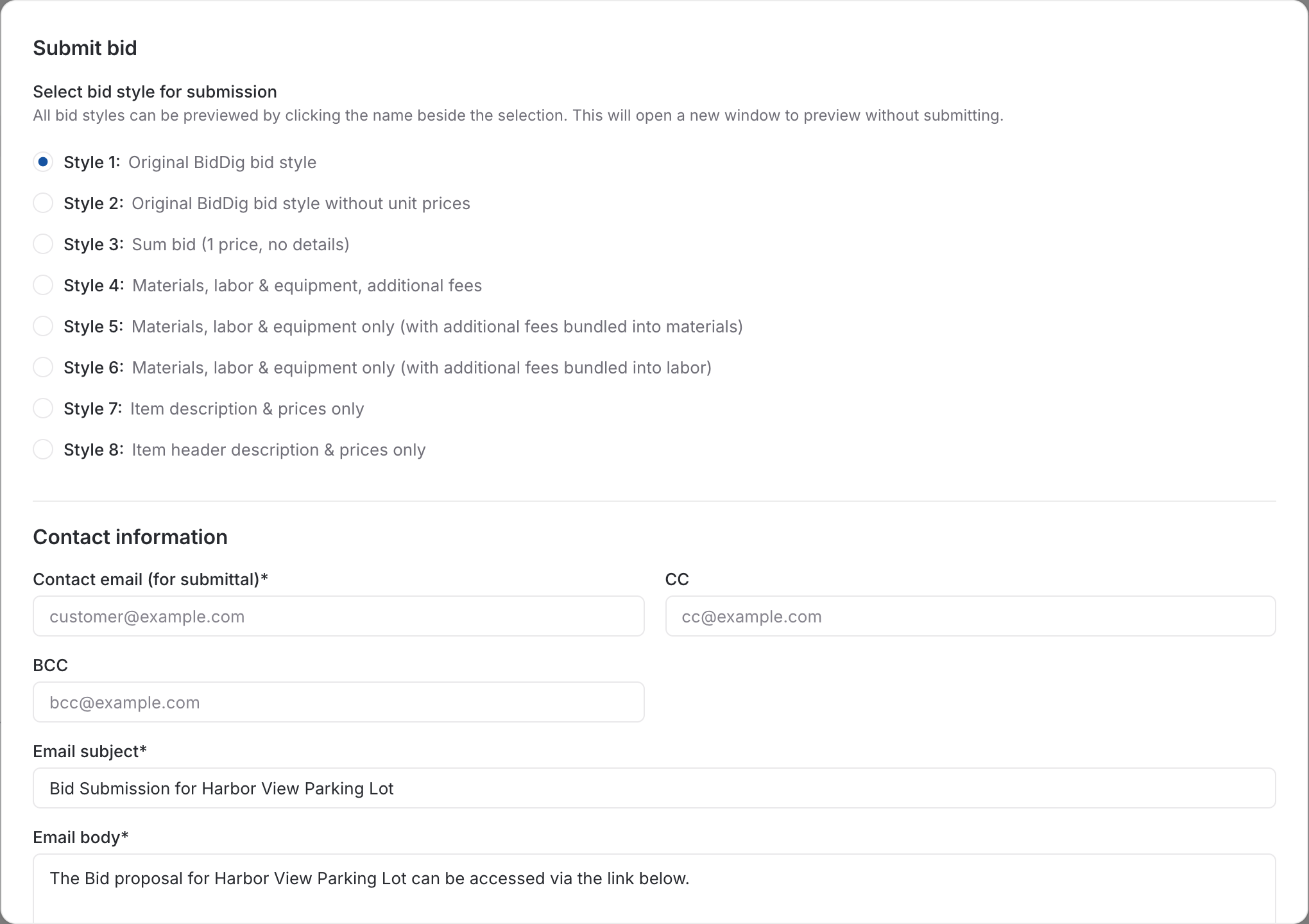
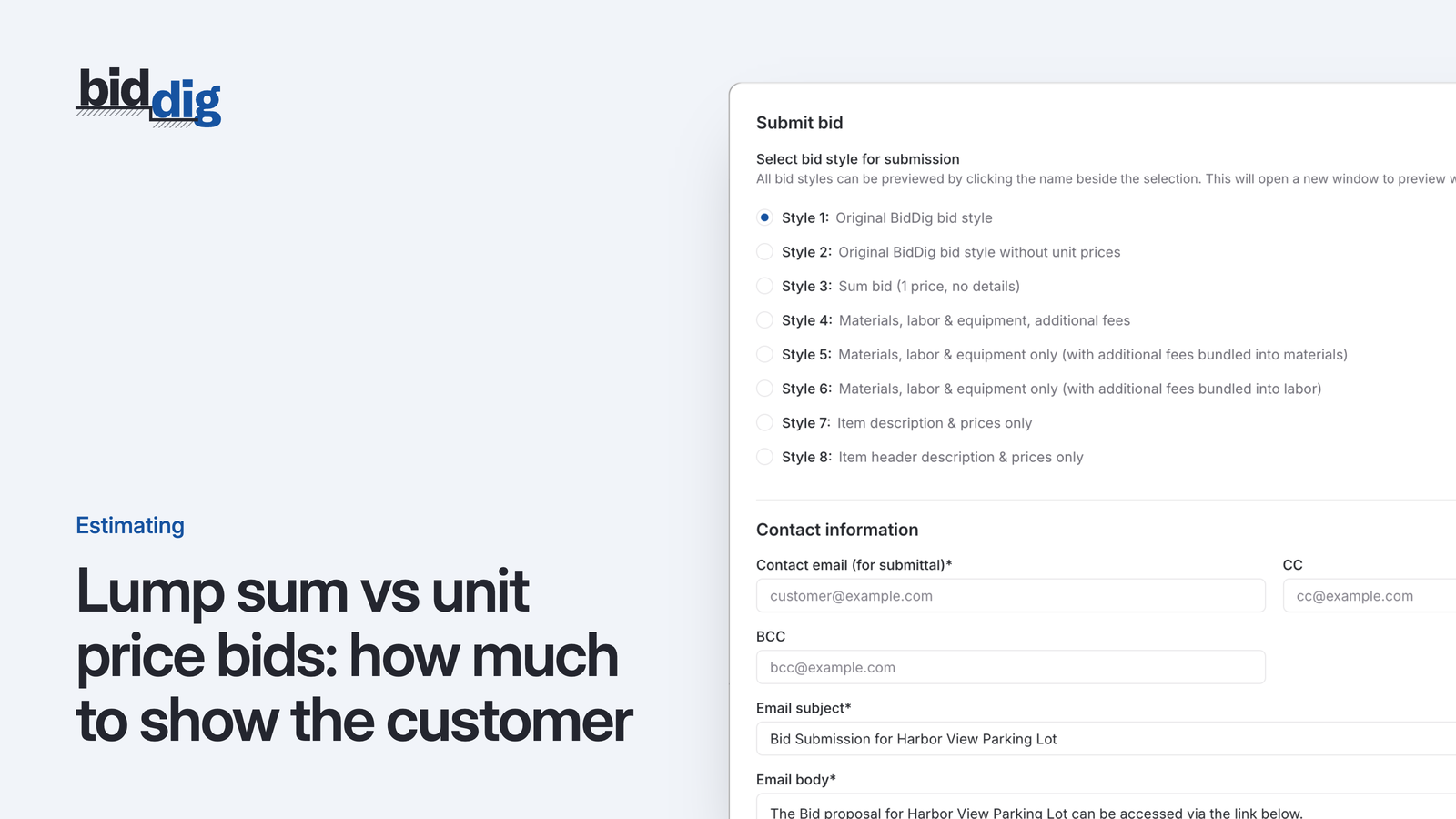
In BidDig, a bid is sent as a PDF in one of eight styles, including full detail, detail without unit prices, lump sum, material, labor and equipment breakdowns, and item or header descriptions with prices. The PDF carries your company logo and is produced from the bid, so the lines and the total come from the same figures. You can add reusable exclusions, qualifications and acceptance text, then email it from the project. See the proposals page, or read how to price overhead and profit in a construction bid. For how the pieces fit together, see construction bidding software. If you are starting from scratch, read how to bid a construction job, step by step.