How to build a bid line item in a construction estimate
A bid line item is built from five costs. Here is what goes in each, how a production rate drives labor and equipment, and one storm drain line worked through.
By the BidDig team, , 5 min read
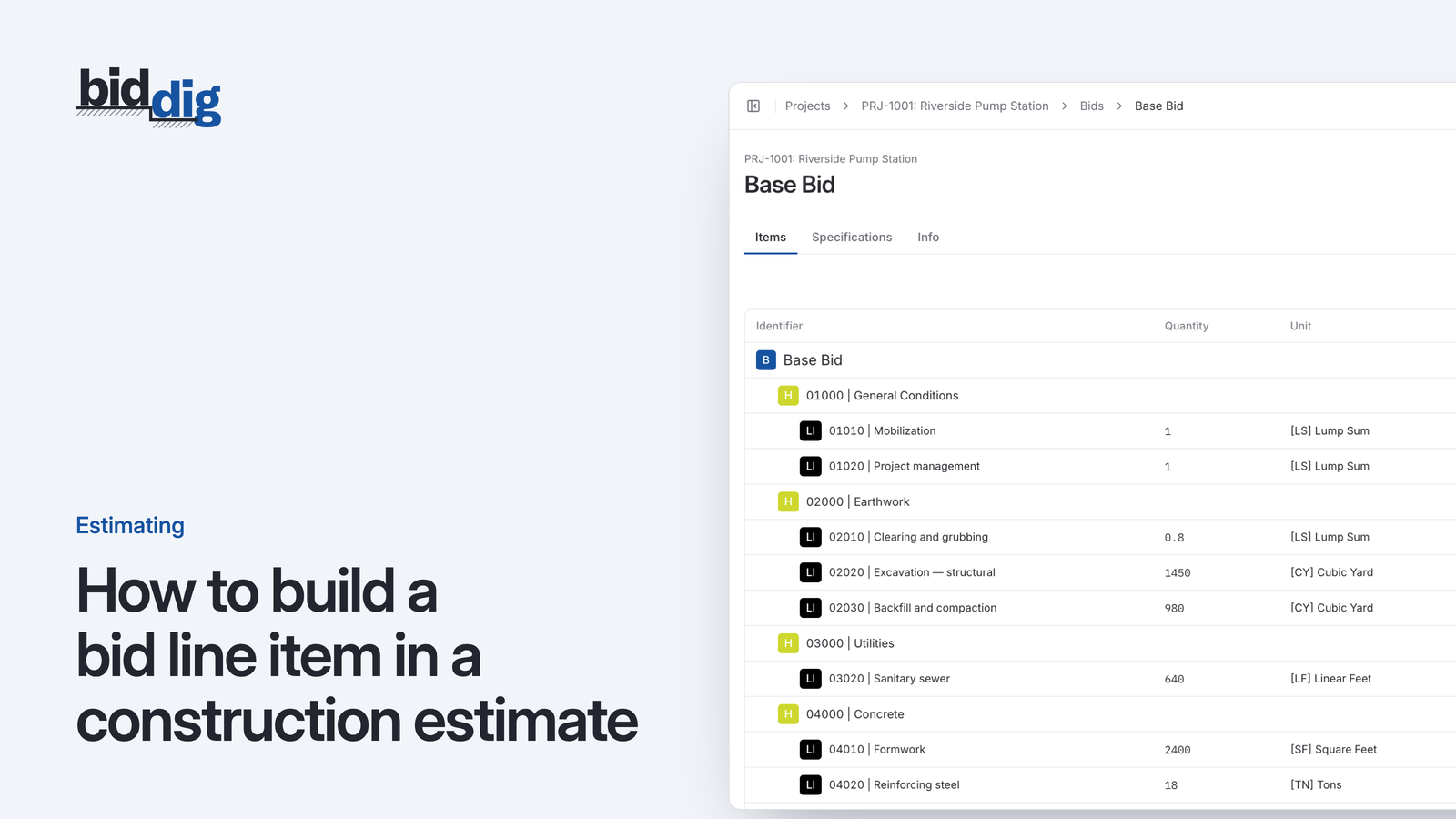
To build a bid line item, give the work a quantity and a unit, then price it as five separate costs: material, labor, equipment, subcontractor and contingency. Labor and equipment come from a production rate, meaning how much a crew installs in a day. Add the five together and divide by the quantity to get the unit price.
Ask an experienced estimator what storm pipe costs to install and you will get an answer straight away: "about sixty a foot". But when the job runs over, a single number cannot tell you why. Was the pipe more expensive, was the crew slower, or did the excavator sit for two days?
A line item priced as one number can only be right or wrong. A line item built from its parts can be checked, adjusted and learned from.
What is included in a bid line item?
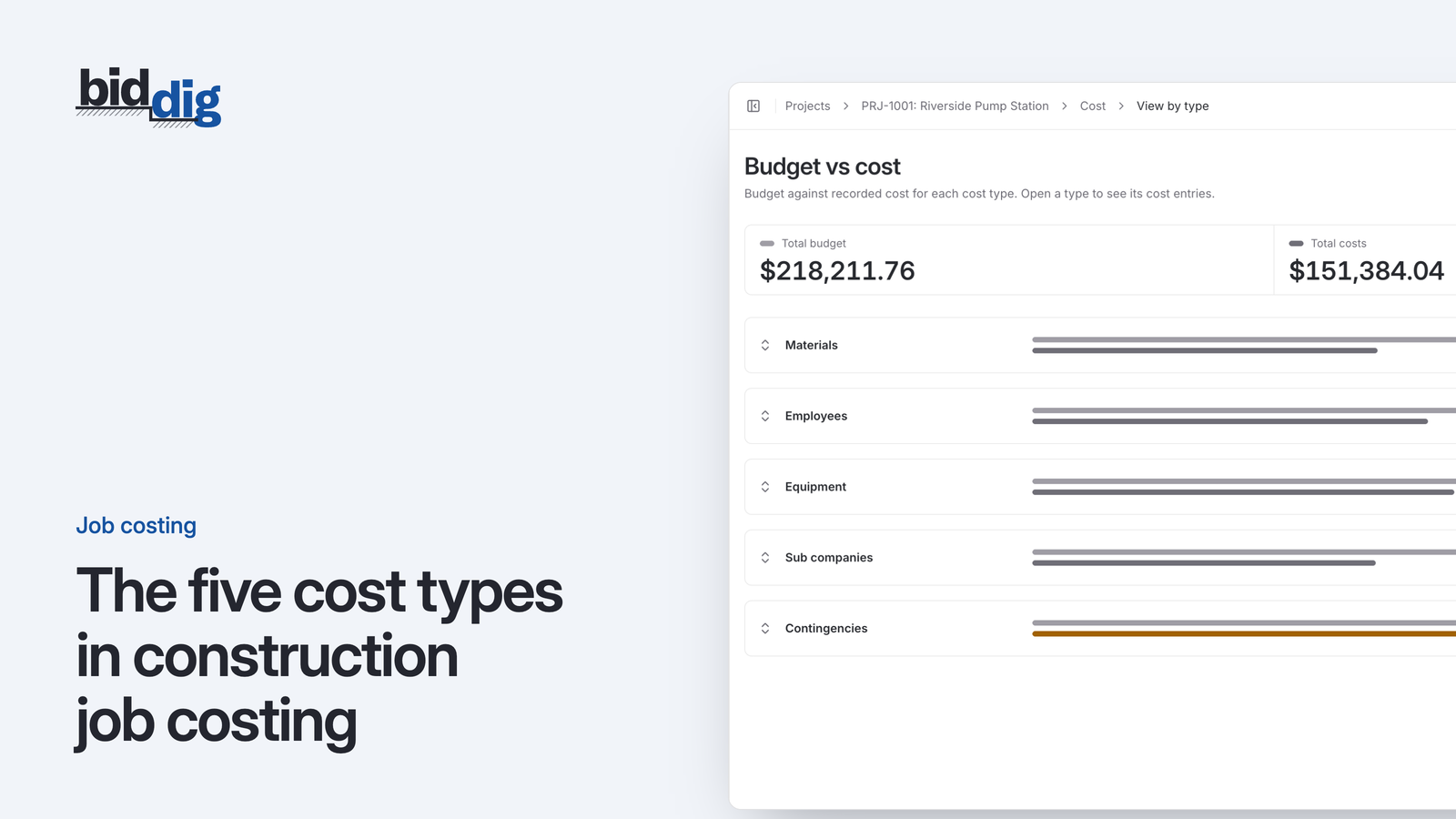
Almost any item of construction work is made of the same five kinds of cost.
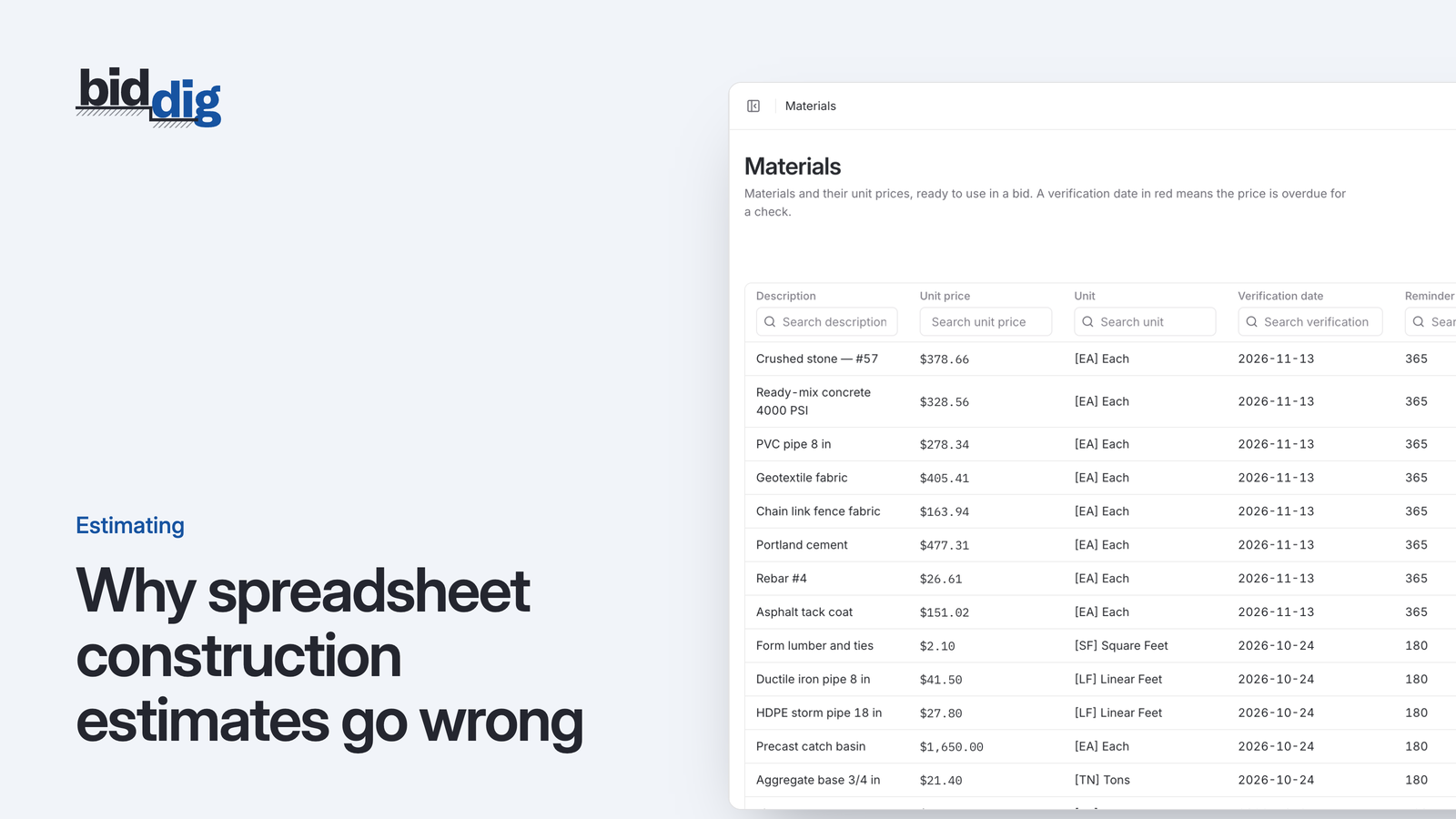
- Material. What gets installed and stays in the job, plus what is used up installing it. Quantity times unit price, with an allowance for waste where it applies.
- Labor. The crew's hours times what each hour really costs, including payroll taxes, insurance and benefits, not just the wage. See labor burden and what an hour really costs.
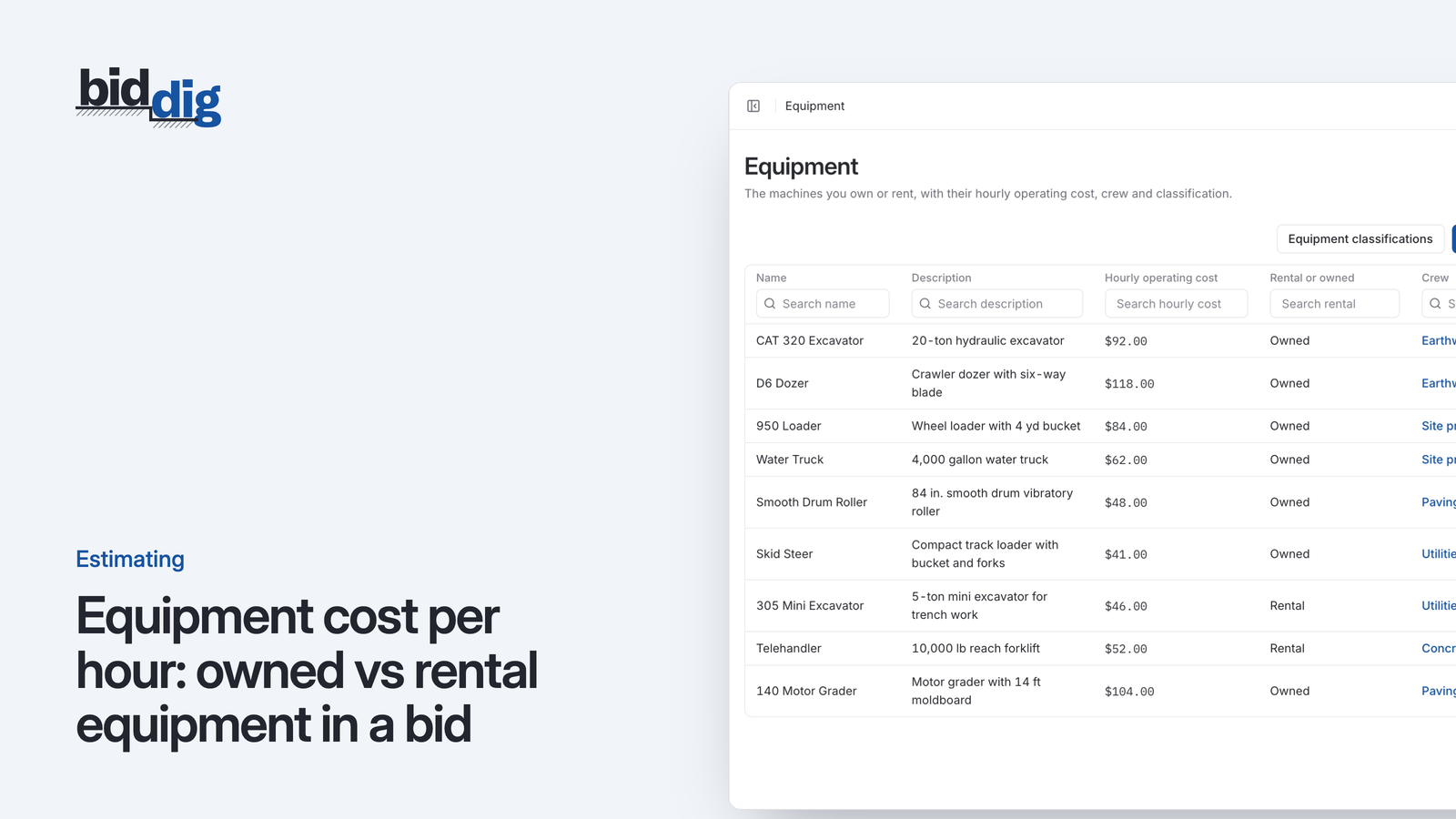
- Equipment. Machine hours times an hourly rate, whether the machine is yours or rented. See owned vs rental equipment in a bid.
- Subcontractor. Any part of the item done by somebody else for a quoted price.
- Contingency. An amount for a specific risk in this item that you can name but cannot be sure of.
Not every line has all five. A line for a sub's lump sum quote may be subcontractor only. A line for delivered stone may be material only. But asking the five questions of each line is how missing costs get found.
How do you use a production rate to price labor and equipment?
Labor and equipment both depend on one figure: how long the work takes. That comes from a production rate, meaning how much of the item a given crew installs in a day.
The production rate is the most important judgment in the line, and the one most worth writing down. "Four-person crew, 120 feet a day" can be checked against the last job. "$28 a foot for labor and equipment" cannot, because it mixes the crew, the rates and the speed into one figure.
Production is also the first thing to adjust for the site. Change the feet per day and the labor and equipment follow.
The steps for any line are the same:
- Set the quantity and the unit.
- Price the material: quantity times unit price, for each material in the item.
- Choose the crew and the production rate, and work out the hours: quantity divided by production per day, times hours per day.
- Price the labor: hours times the crew's cost per hour.
- Price the equipment: hours times each machine's hourly rate.
- Add any subcontractor quote for part of the item.
- Name the risk and add a contingency for it.
- Add the five together, and divide by the quantity for a unit price.
Bid line item example: 600 feet of storm drain pipe
Say the item is 600 linear feet of 12-inch storm drain pipe. The figures are examples to show the method. Replace them with your own.
Material
- Pipe: 600 LF x $28.00 = $16,800
- Bedding stone: 150 TN x $24.00 = $3,600
- Material total: $20,400
Labor
The crew is a foreman at $55.00 an hour, an operator at $48.00 and two laborers at $36.00 each, all at full cost. That is 55 + 48 + 36 + 36 = $175.00 per crew hour.
At 120 feet a day, 600 feet takes 600 / 120 = 5 days, or 5 x 8 = 40 hours.
- Labor total: 40 x $175.00 = $7,000
Equipment
- Excavator: 40 HR x $85.00 = $3,400
- Loader: 40 HR x $60.00 = $2,400
- Plate compactor: 40 HR x $15.00 = $600
- Equipment total: $6,400
Subcontractor
- Video inspection of the finished line, quoted lump sum: $1,500
Contingency
The risk here is slow progress where the trench crosses existing utilities. One extra crew day would cost 8 x $175.00 = $1,400 in labor and 8 x (85 + 60 + 15) = $1,280 in equipment, $2,680 in all. You judge that half a day is a fair allowance.
- Contingency: $2,680 / 2 = $1,340
The line item total
| Cost type | Amount |
|---|---|
| Material | $20,400 |
| Labor | $7,000 |
| Equipment | $6,400 |
| Subcontractor | $1,500 |
| Contingency | $1,340 |
| Line item cost | $36,640 |
Divided by the quantity, that is 36,640 / 600 = $61.07 per linear foot. The estimator's "about sixty a foot" was close. The difference is that now you can see it is $34.00 of material, $11.67 of labor, $10.67 of equipment, $2.50 of sub and $2.23 of contingency, and each of those can be tested.
What should not go in a bid line item?
A line item is direct cost: what it takes to put that piece of work in place. Several things belong elsewhere in the bid.
- Overhead and profit. These are applied to the cost of the whole bid at set rates. Burying a little extra in each line means nobody knows the true cost or the true markup. See how to price overhead and profit in a construction bid.
- Tax and bond. These are calculated on the bid, not guessed line by line.
- Job-wide costs. Mobilization, supervision, a site trailer, traffic control for the whole job. Give them their own line items so they are visible, instead of spreading them thinly across the work items.
- Padding. Rounding every rate up "to be safe" is contingency with no name and no size. If there is a risk, put it in the contingency for that line and say what it is for.
Why break a unit price into cost types?
The same five cost types are how the job gets tracked once you win it. If the estimate said $7,000 of labor for the pipe and the timesheets show $9,100, that is 9,100 / 175 = 52 crew hours against the 40 you bid. The crew laid about 92 feet a day, not 120, and the next pipe bid can use that.
That only works if the estimate and the job use the same lines and the same cost types. A bid priced at "$60 a foot" gives the field nothing to measure against. Construction job costing explained goes through that comparison.
How BidDig handles line items
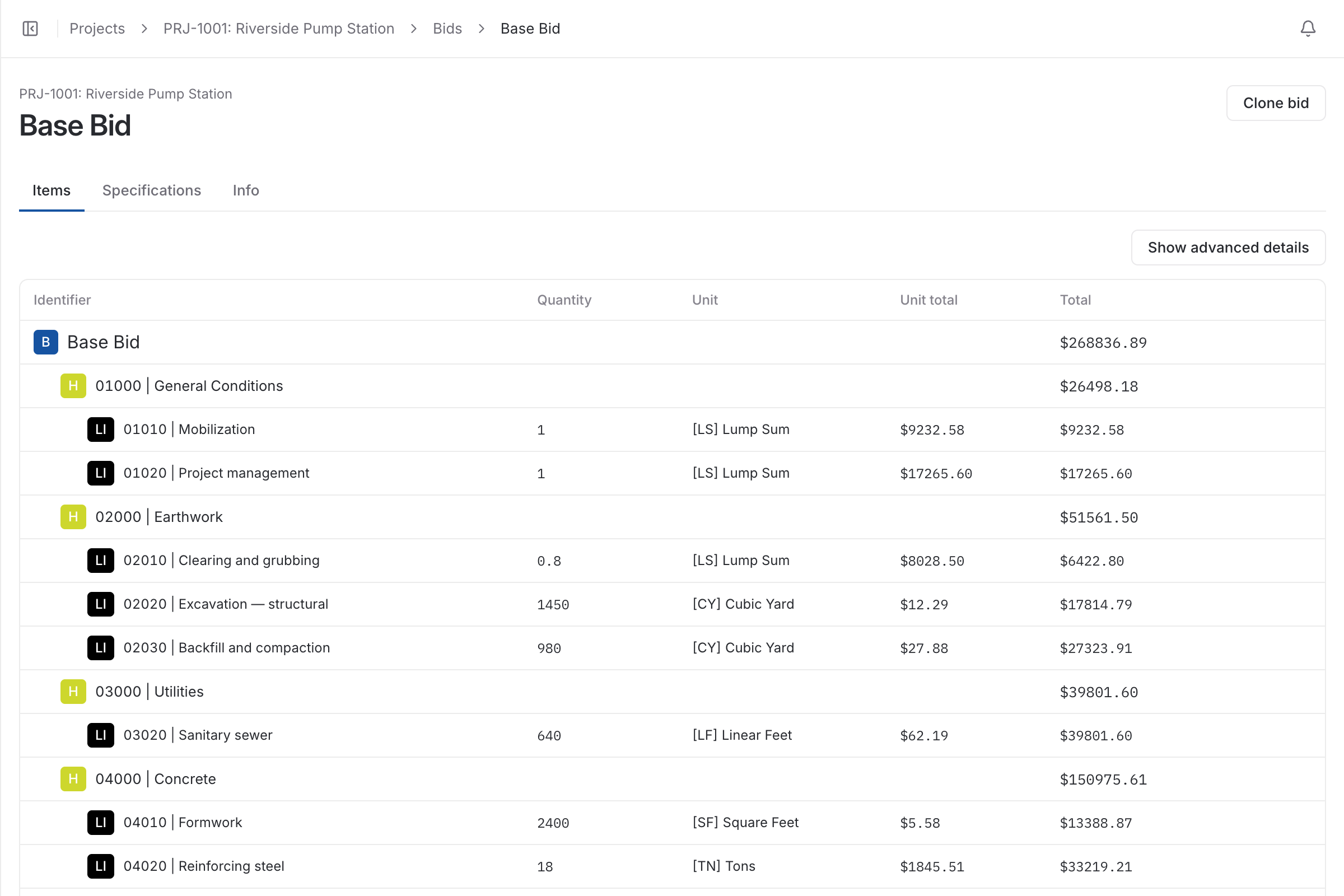
In BidDig, each line item is costed as material, labor, equipment, subcontractor and contingency, using your own catalog of employee classifications, equipment with an hourly operating cost, materials with unit prices, subcontractors and units such as CY, LF, SF, SY, TN, HR and LS. Line items sit under bid item headers. Tax, bond, overhead and profit are calculated from default rates. When the bid is awarded, its line items become the budget that job costs are recorded against. See the estimating and bidding page. For how the pieces fit together, see construction estimating software. If you are starting from scratch, read how to bid a construction job, step by step.