Construction job over budget: what to do at 80 percent of budget
A line at 80 percent of its budget is either nearly finished or in trouble. A few questions tell you which, and what you can still do about it.
By the BidDig team, , 5 min read
When a construction job is going over budget, start at the line item, not the job total. Compare the share of the line's budget that is spent with the share of the quantity in place, project the final cost at the current cost per unit, find which cost type is driving it, and act while work remains. Checking at 80 percent of budget leaves room to do that.
Often an overrun is found later than that. A line item goes over budget. The report shows it in red. The project manager calls the superintendent, who explains that the work was finished last week.
A warning at 100 percent comes too late for that line. The money is spent, and usually the work is done or close to it. There is nothing left to manage. All you can do is explain it.
A warning that comes earlier is different. At 80 percent of budget there is, in most cases, still work to do on the line and so still decisions to make. The 80 percent figure is a working threshold, not an industry rule, and you could reasonably pick another number. The principle is what matters: the trigger has to come before the budget is gone.
Is 80 percent of budget spent a problem?
Reaching 80 percent of budget is not a problem on its own. Every line that finishes on budget passes through 80 percent on the way.
What matters is how much of the work is done at the moment the line gets there. A line that has spent 80 percent of its budget with 85 percent of the work in place is ahead. The same line with 60 percent of the work in place is heading well over.
So the 80 percent mark is a prompt to ask a question. It is not a verdict.
How to tell if a line item will go over budget
Compare two numbers: the share of the budget that is spent and the share of the quantity that is complete.
Here is an example with made-up figures. Say a line item is 1,000 SY of paving with a budget of $30,000 in estimated cost. That is $30 per SY. Cost recorded so far is $24,000, which is 80 percent.
If 600 SY is done:
- Cost per SY so far is $40 ($24,000 divided by 600).
- The 400 SY remaining, at $40, will cost another $16,000.
- Projected final cost is $40,000, which is $10,000 over the $30,000 budget.
If 850 SY is done:
- Cost per SY so far is about $28.24 ($24,000 divided by 850).
- The 150 SY remaining, at that rate, will cost about $4,235.
- Projected final cost is about $28,235, which is roughly $1,765 under budget.
The cost figure and the percentage are identical in both cases, and the outcomes are opposite. The only way to tell them apart is to get the quantity in place from the field. That takes one phone call.
Why is the job over budget? Six causes to check
If the line is behind, find out why before deciding what to do.
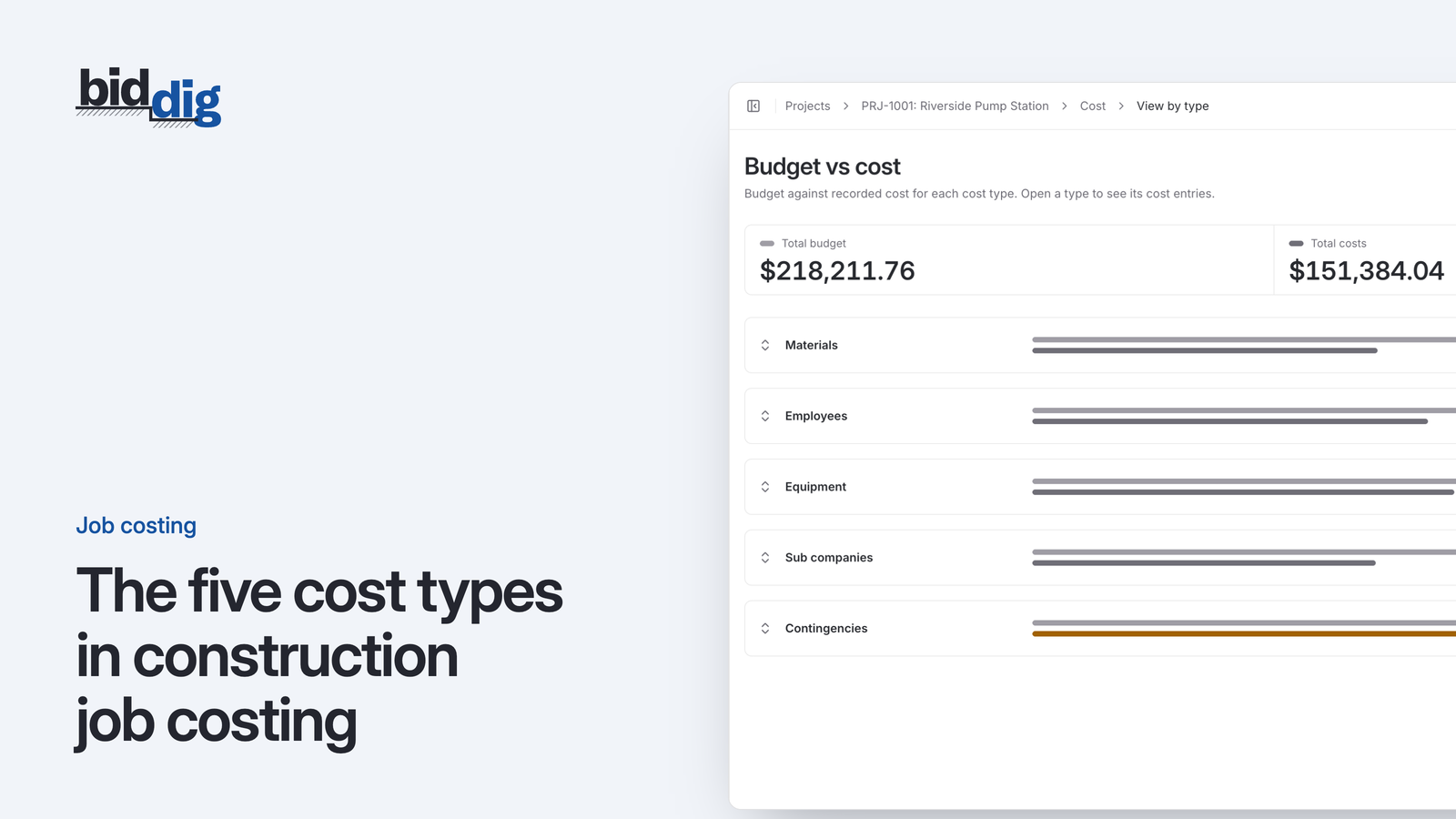
Which cost type is driving it? Open the line by material, labor, equipment and subcontractor. Labor and equipment running ahead points to production. Material running ahead points to price, waste or quantity.
Was the material bought up front? If all the material for a line was delivered in the first week, the line can sit at 80 percent of budget with little work done and be perfectly on plan. Check what the remaining cost actually is. If only labor and equipment are left, compare those with what remains of their own budget.
Is everything on the line supposed to be there? Hours get recorded against the wrong line. A bill gets coded to the wrong job. Before changing anything on site, confirm the costs belong to this line.
Is the quantity in the field the same as the quantity in the bid? If the bid had 1,000 SY and the site turns out to need 1,150 SY, the line will run over however well the crew performs. That is a quantity problem, not a production problem.
Did the scope change? If the crew is doing work on this line that was not in the contract, such as extra depth or added areas, the cause is an unpriced change.
Is it a one-time hit or a rate? A breakdown that cost two days is done. A crew producing 20 percent less per day than the bid assumed will keep doing so until something changes.
What to do when a job is going over budget
What you can do depends on the answers. With work remaining, the choices usually come down to these.
- Fix the production. Change the crew size or makeup, change the equipment, resequence the work, or clear whatever is holding the crew up. This is the only option that actually lowers the final cost of the line.
- Correct the records. If costs are miscoded, move them to the right line. The line's real position may be fine.
- Raise a change order. If the overrun comes from extra scope or site conditions that differ from what was priced, price the difference and send it before more of the work is done. See pricing change orders before the work is done.
- Revisit the purchase. If material is the driver and more is still to be bought, check prices and quantities for what remains.
- Accept it and update the forecast. Sometimes the estimate was simply too low and nothing on site will change that. Work out the projected overrun, find out whether other lines can absorb it, and tell whoever needs to know now, not at the end.
Whatever the outcome, write down the cause in a sentence or two. "Subgrade softer than expected, extra stone." "Bid assumed 250 SY a day, crew averaging 180." That note is what makes the next estimate better.
How to catch cost overruns earlier
Looking at one line when it changes color is useful. Looking at all of them once a week is better, because you catch lines that are at 50 percent of budget with 30 percent of the work done, well before any threshold.
A short weekly pass through each active job, line by line, with quantities from the field next to the costs, is enough. See the weekly job cost review for one way to run it.
How BidDig flags a line going over budget
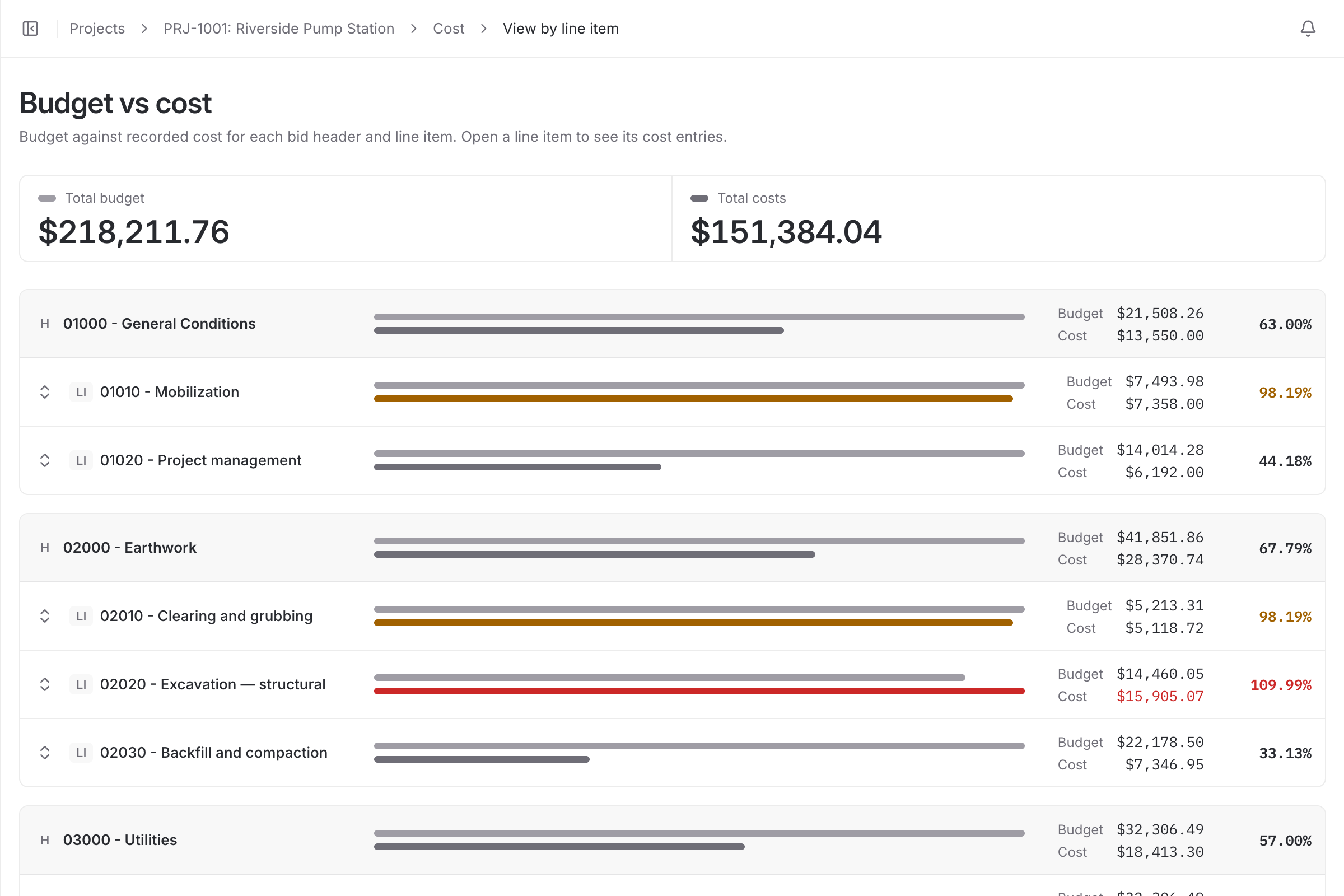
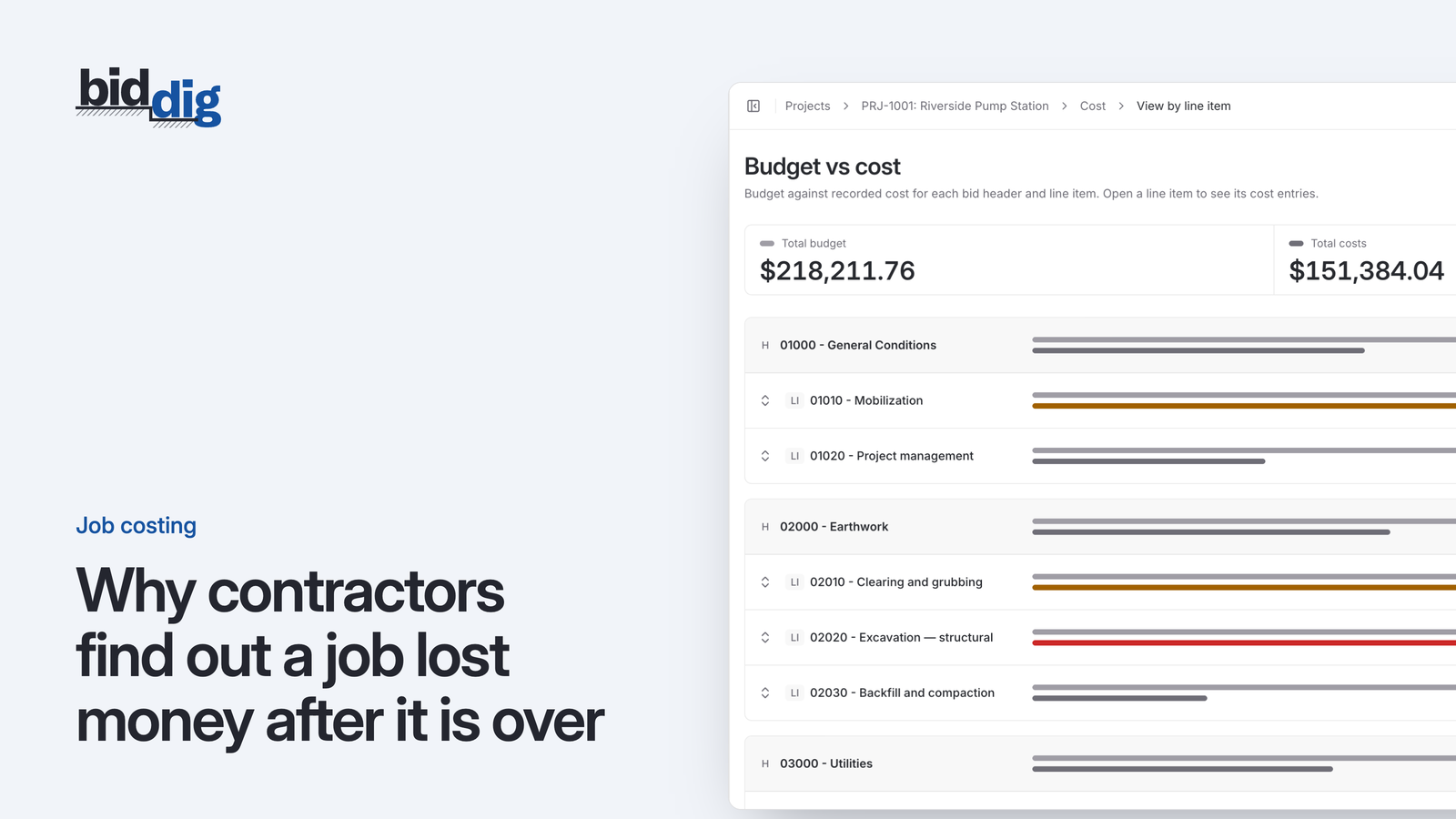
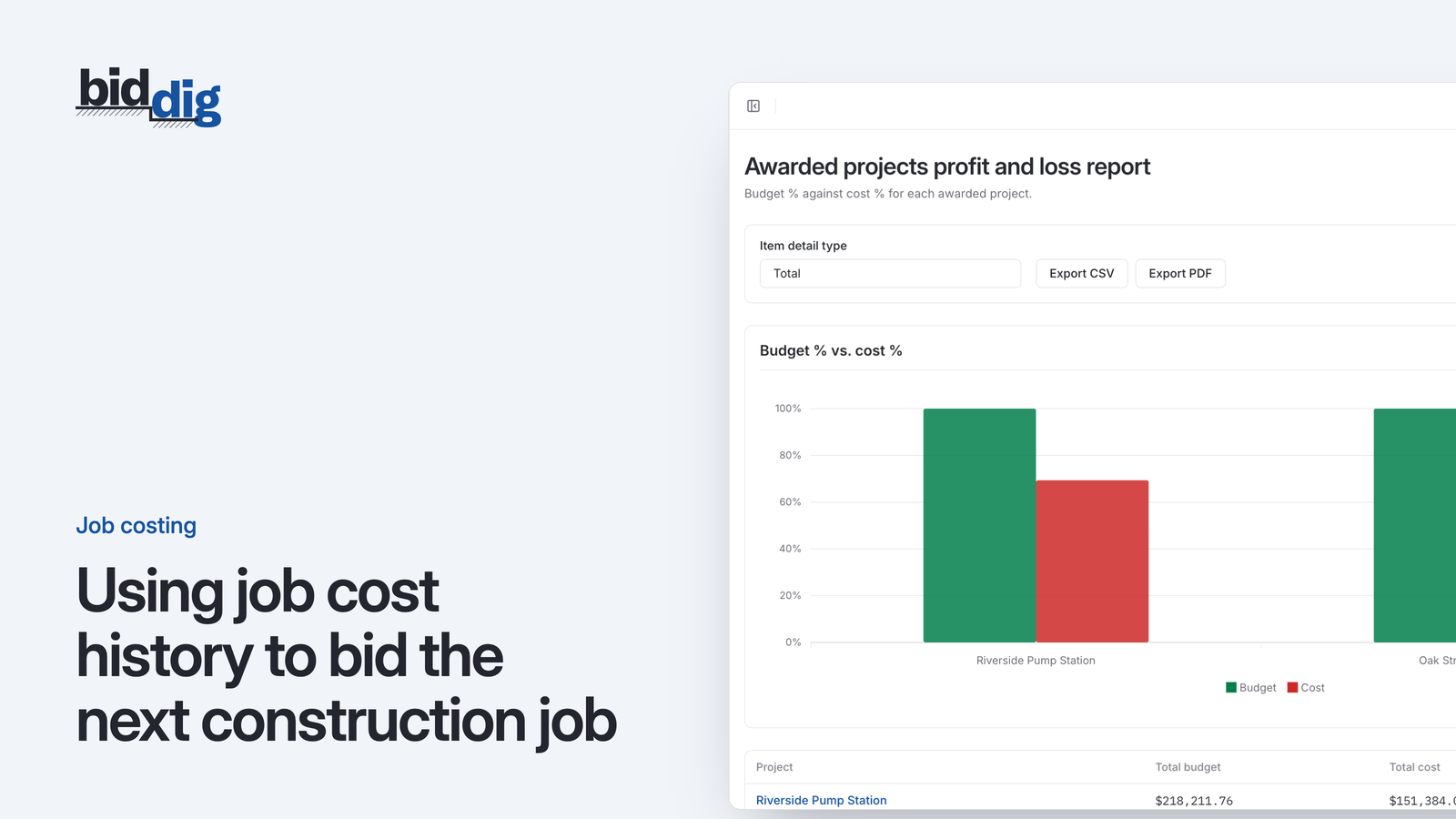
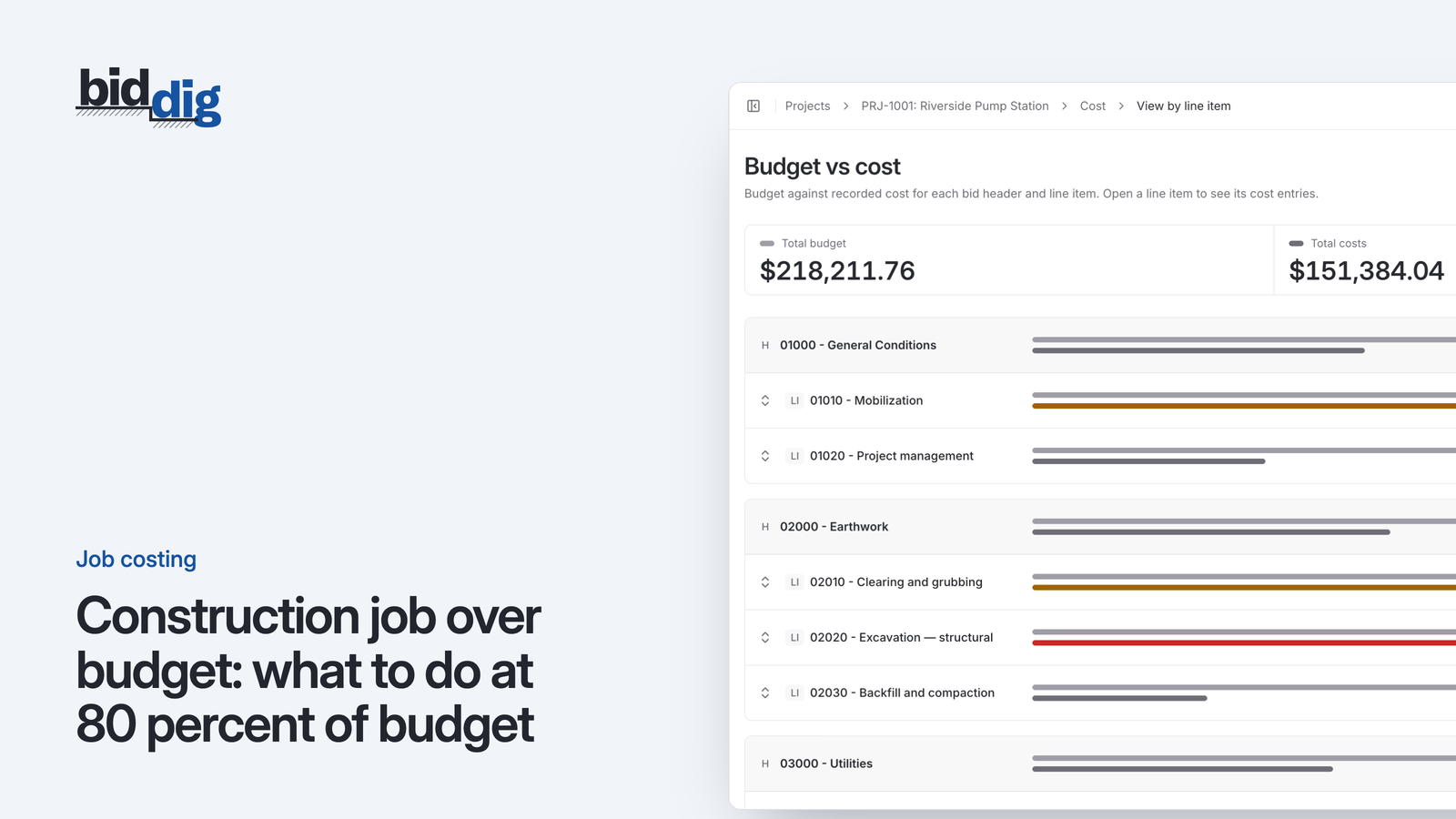
In BidDig the awarded bid's line items are the budget, at estimated cost before markup, and costs are recorded against those lines. Budget vs actual is shown by cost type and by line item. A line turns orange from 80 percent of budget and red above 100 percent, so the lines to ask about stand out. The color reflects budget spent, so compare it with the quantity in place before deciding what it means. See job costing, and read budget vs actual by cost type or by line item. For how the pieces fit together, see construction job costing software. For the basics, read how to track job costs in construction.