Why contractors find out a job lost money after it is over
The bid lives in one place, the costs in another, under different names and on a different schedule. That gap is why the bad news arrives when nothing can be done about it.
By the BidDig team, , 5 min read
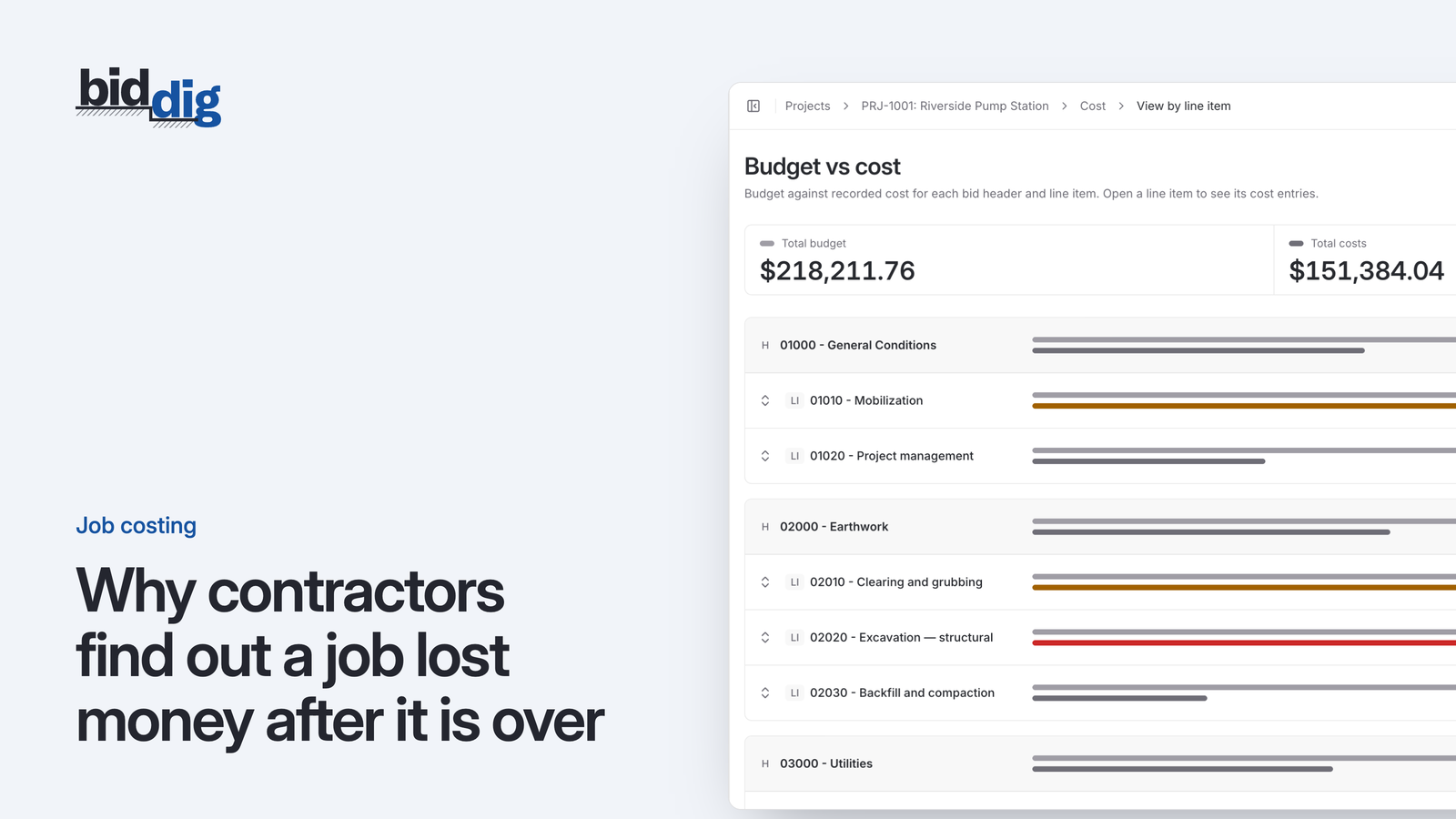
Contractors find out a job lost money after it is over because the bid and the costs are kept in different places, under different names, and the costs reach the office late. The bid is organized by line item and the costs by kind of expense, so the two can only be compared for the whole job, once it is finished.
It usually goes like this. The job wrapped up six weeks ago. The final bills are in, the bookkeeper closes it out, and the number is well short of the profit in the bid. You ask what happened. Nobody knows. The superintendent remembers the rock in the trench. The estimator thinks the pipe price went up. Both might be right. There is no way to check.
The frustrating part is that every fact needed to see this coming existed during the job. The hours were written down. The bills were paid. The bid had the numbers. They were never put next to each other while it still mattered.
Here is why that happens, and what it takes to change it.
Why the estimate is not compared with actual costs during the job
The bid usually lives in a spreadsheet or an estimating file, organized the way the estimator thinks: by line item, with quantities, production rates and unit costs.
The costs live somewhere else. Hours are on paper timesheets or in a payroll system. Supplier bills are in the accounting package. Equipment time may not be recorded anywhere at all.
Nothing connects the two. To compare them, someone has to pull numbers out of each and line them up by hand. That is slow, so it gets done once, at the end, if it gets done at all.
Cost codes that do not match the bid
Even when someone does sit down to compare, the two sides do not match.
The bid has a line called "8 inch water main, 1,200 LF". The accounting system has the same money spread across "materials", "wages" and "equipment rental" for the whole job. The timesheet says "Main St, 8 hours".
To answer "did the water main cost what we bid", you would have to work out which share of the job's wages went to the water main. That information was never captured. The foreman knew on the day. It was not written down, so it is gone.
This is the real cause. The bid is organized by piece of work. The costs are organized by kind of expense. Unless every cost is tagged with the line item it belongs to at the moment it is recorded, the two can only be compared at the level of the whole job. A whole-job comparison tells you that you lost money. It cannot tell you where.
Why job cost information arrives too late
Timing compounds the problem. Consider when each piece of cost information reaches the office in a company that runs on paper timesheets and month-end bills:
| Cost | When it happens | When the office often sees it |
|---|---|---|
| Labor hours | Daily | End of the pay period |
| Equipment hours | Daily | Sometimes never |
| Material | On delivery | When the supplier bill arrives |
| Subcontractor | As work is done | When the pay application arrives |
A line item that takes three weeks to build can be finished before the first cost against it is visible. By the time a report could show the overrun, the work is done and the money is spent.
There is a second timing trap. In the early weeks of a job, total cost is always well under total budget, because most of the work has not happened yet. A job that is bleeding on its first two line items still looks comfortable in total. The total only turns bad near the end, when the remaining budget runs out.
How to tell a job is losing money before it ends
Seeing a problem while it can still be fixed needs four things to be true.
The budget is the bid, line for line. Not a single job total, and not the bid re-sorted into accounting codes. The same line items, at estimated cost before overhead and profit.
Every cost is recorded against a line item. Hours, equipment time, material and subcontractor costs each carry the job and the line. This has to happen at the point of entry. It cannot be reconstructed later.
Costs are entered close to when they happen. Hours daily or weekly. Bills when they arrive. A comparison is only as current as its slowest input.
Someone looks at lines, not just totals, on a schedule. Once a week is enough for most jobs. The question is not "is the job under budget" but "which lines are spending faster than they are progressing".
Here is what that last question looks like, with example figures. Say a line item was bid with 300 labor hours. Three weeks in, 240 hours have been recorded against it, and the superintendent says the work is about half done.
- Hours used: 240 of 300, which is 80 percent.
- Work done: about 50 percent.
- At the same rate, the line finishes at 480 hours (240 divided by 0.5).
- That is 180 hours over. At a labor cost of $45 per hour, it is $8,100.
At this point half the work remains. You can change the crew, change the method, check whether the quantity in the field is more than the quantity in the bid, or raise a change order if the conditions differ from what was priced. Six weeks after the job closes, the same $8,100 is just a number.
How to start tracking job costs by line item
You do not need to fix everything at once. In order of payoff:
- Have foremen record hours against line items, not just against the job.
- Record equipment hours the same way as labor hours.
- Code each material and subcontractor bill to a line item when it comes in.
- Review budget vs actual by line item every week. See the weekly job cost review for a routine.
The first one alone changes what you can see, because labor depends on production, and production is the part of a bid that is hardest to estimate.
How BidDig handles it
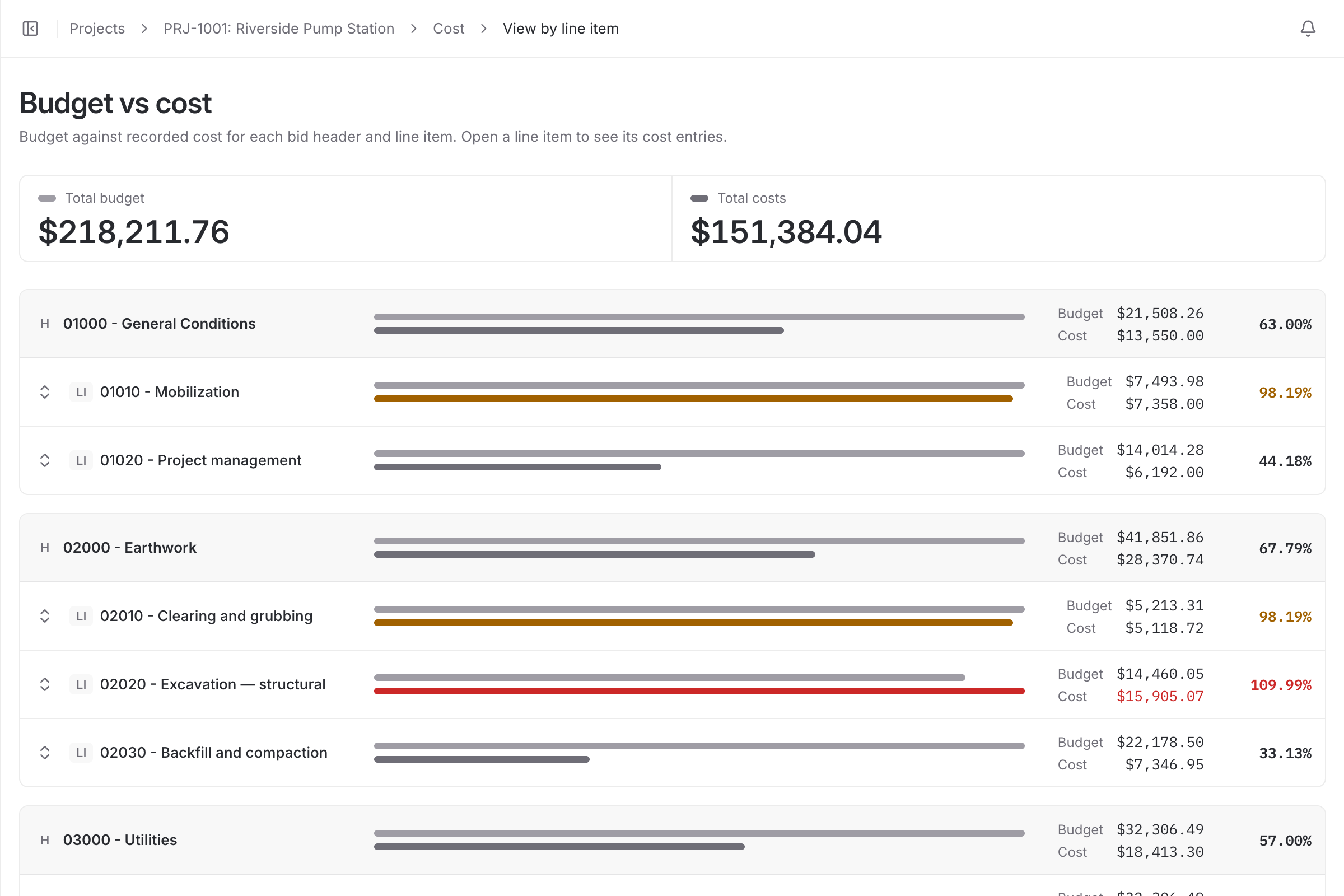
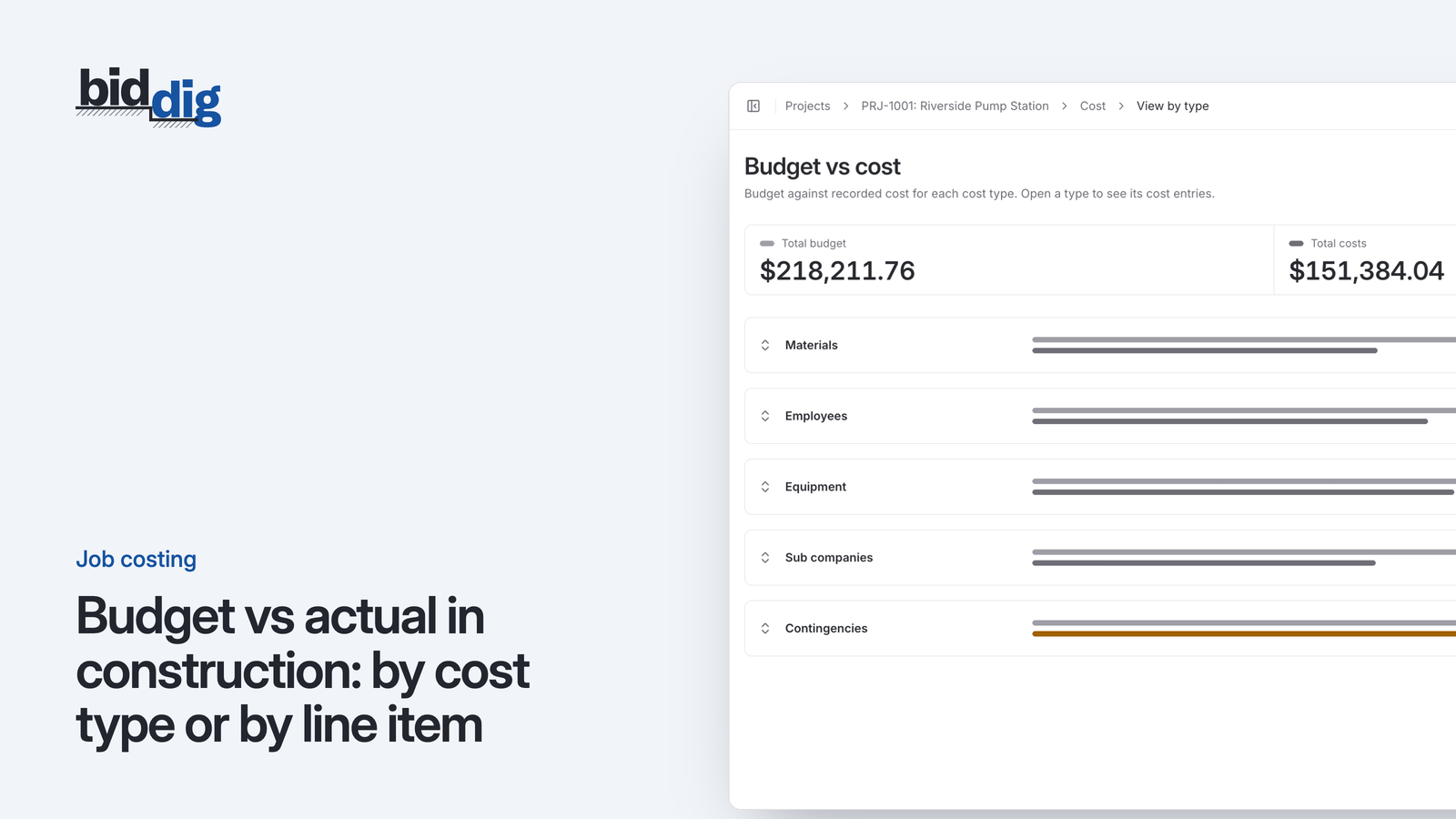
BidDig keeps the bid and the costs in one place under one set of line items. When a bid is awarded, its line items are the budget, at estimated cost before markup. Hours entered on a timesheet against a project and line item are job cost when saved, and material, equipment, subcontractor and miscellaneous costs are recorded against the same lines. A line turns orange from 80 percent of budget and red above 100 percent. See job costing, or read construction job costing explained for the basics. For how the pieces fit together, see construction job costing software.