How to keep material prices current in construction estimates
A material price is only true on the day somebody checked it. Here is a routine for re-verifying prices, and ways to protect a bid when prices move after it is sent.
By the BidDig team, , 5 min read
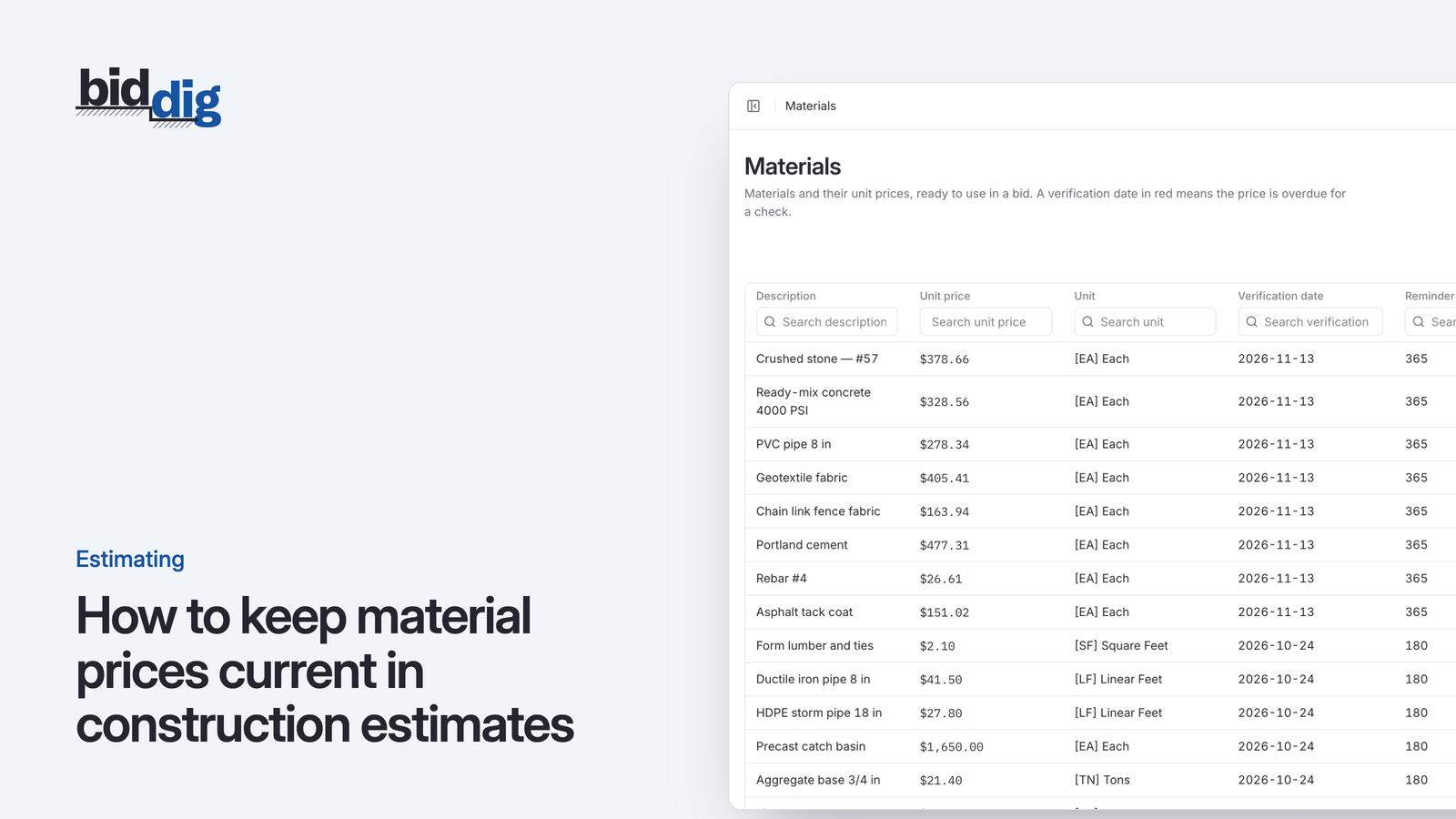
To keep material prices current in construction estimates, record the date each price was checked and give it a shelf life based on how fast it moves and how much of a job it makes up. Re-verify whatever has expired on a fixed schedule, update the list whenever an invoice shows a different number, and get a fresh quote for the big items.
Why do old material prices cost money on a bid?
Say you price a job using $22.00 a ton for crushed stone because that is what the estimate has always used. You win it. The first load arrives with an invoice at $24.50. On 1,200 tons, that is 2.50 x 1,200 = $3,000 gone before the crew has started.
Nobody made an arithmetic mistake. The price was right once. The estimate just had no way of saying how long ago.
Every material price in your estimate came from somewhere: a supplier quote, a price sheet, an invoice from another job. Each of those had a date. When the number is typed into an estimate, the date usually gets left behind.
That missing date is the risk. A price checked last week and a price checked two years ago look identical in a cell. The estimator using them has no reason to trust one less than the other.
So treat age as part of the price. A price is not "22.00". It is "22.00 a ton, from this supplier, checked on this date". Once the date is recorded, an old price becomes visible, and a visible risk can be managed.
How often should you update material prices?
Checking every price before every bid is not realistic, and it is not necessary. Sort your materials by how much damage a wrong price can do.
Two questions decide it:
- How much of your typical job cost does this material make up?
- How quickly does its price move?
| Kind of material | Example | How often to re-verify |
|---|---|---|
| Large share of cost, price moves | Pipe, steel, asphalt, lumber, fuel | Before every bid that uses a meaningful quantity |
| Large share of cost, price steadier | Aggregate, ready-mix concrete | On a short fixed interval |
| Small share of cost | Fittings, fasteners, marking paint | On a longer fixed interval |
The intervals are yours to set from your own experience with your own suppliers. The point is to have one for each group, written down, so that "current" means something specific.
How do you set up a material price verification routine?
A routine that works is small enough to actually get done.
- Record the date with the price. Every time a price is entered or confirmed, the date goes with it.
- Give each price a shelf life. Decide how long that price can be used before it must be checked again.
- Name an owner. One person is responsible for keeping prices current. If it is everybody's job, it is nobody's.
- Check on a schedule. Set a regular time to work through whatever has passed its shelf life.
- Update from invoices. When an invoice shows a price different from the one in your list, change the list that day. This is the cheapest price check you will ever get.
- Get a job-specific quote for the big items. For any material that makes up a large part of one bid, ask the supplier for a written quote for that job, with the quantity, the delivery terms and how long the quote is good for.
Also record what the price includes. A price per ton picked up at the quarry and a price per ton delivered to site are different numbers.
How do you protect a bid from material price increases?
Your prices can be current on bid day and still be wrong by the time you buy. The gap between bid and purchase is where the exposure sits, and on some jobs that gap runs to months.
There are several ways to deal with it, and they can be combined.
- Limit how long your price is valid. State on the proposal that the price holds for a set number of days. After that you can reprice. See how to write exclusions and qualifications that hold up.
- Match your validity to your supplier's. If the pipe quote is good for 15 days and your proposal is good for 60, you are carrying 45 days of price risk for free. Ask the supplier for a longer hold, or shorten your own.
- Qualify the volatile items. This is often called a material price escalation clause. State that the price for a named material is based on a quote of a given date, and that a change in the supplier's price at the time of purchase adjusts the contract price. Whether a customer accepts that depends on the customer and the market, but it has to be in the proposal to be in the deal.
- Carry a contingency for it. Where you cannot limit or pass on the risk, price it. Say a job needs $40,000 of pipe and you judge that a 5 percent rise before purchase is a real possibility. That is 40,000 x 0.05 = $2,000 of exposure, and you can decide how much of it to carry. See how much contingency to carry in a bid.
- Buy early. When you win, place the order or lock the price for the big items straight away, if you have somewhere to store them or the supplier will hold them.
How do you check material prices after the job?
After the job, compare what you paid for material with what the estimate carried. Where the two differ, find out which of three things happened:
- The price was old. Update the price list, and shorten that material's shelf life if it keeps happening.
- The quantity was off. That is a measuring problem, and the price list is fine.
- Waste was higher than allowed. Change the waste allowance for that material, not its price.
Each has a different fix, and only the first one is a pricing problem.
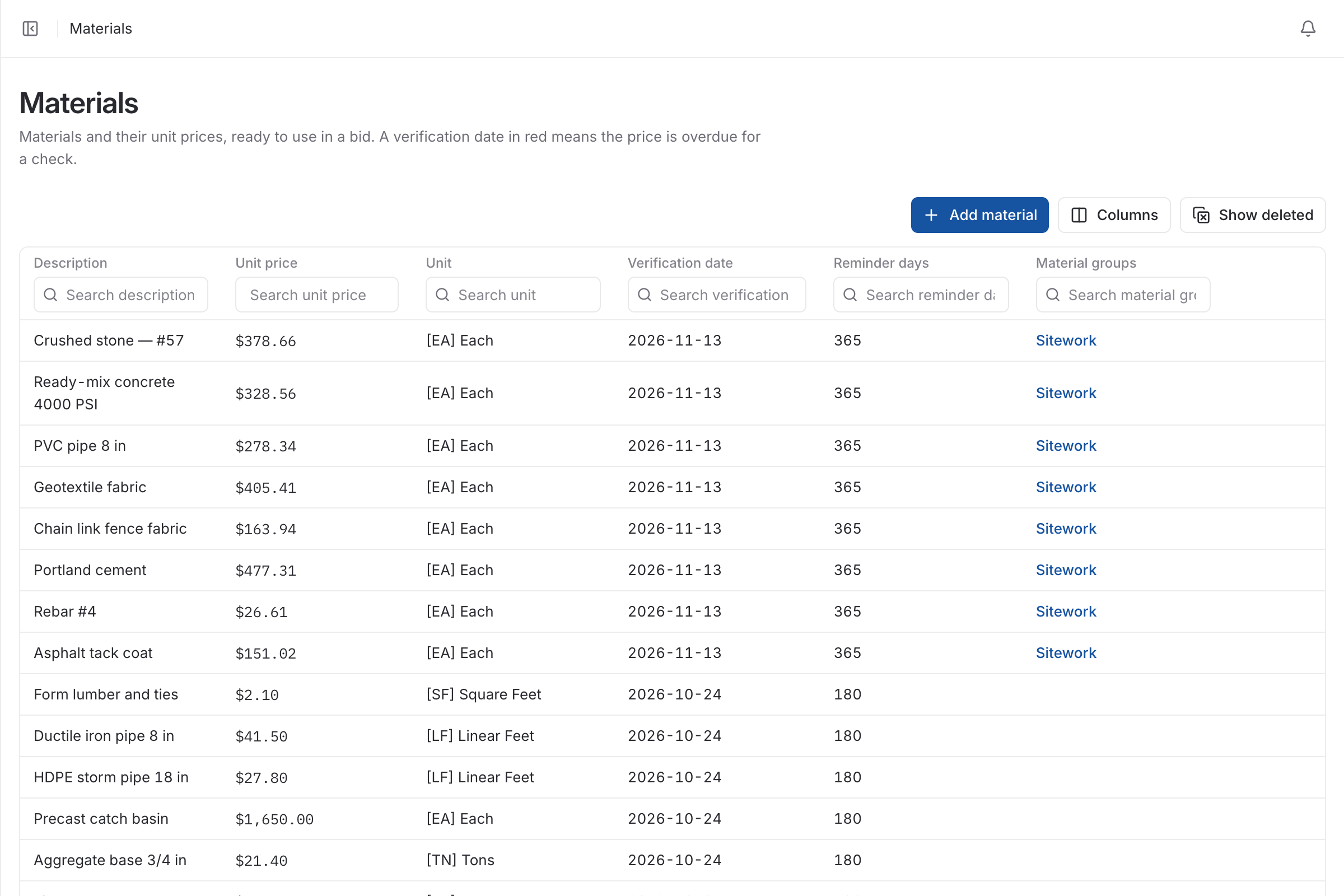
How BidDig handles material prices
In BidDig, materials live in the company catalog with a unit, a unit price and groups. Each material price has a verification date and a re-verify window, and the app shows a notice when prices are overdue for checking. Bids are built from that catalog. Read more on the estimating and bidding page, or see why estimates copied from the last job drift. For how the pieces fit together, see construction estimating software. If you are starting from scratch, read how to bid a construction job, step by step.