How much contingency to carry in a construction bid
There is no single right percentage. Contingency is a price for specific risks, and the way to size it is to name those risks, price each one and weigh how likely it is.
By the BidDig team, , 5 min read
There is no fixed percentage of contingency that is right for every construction bid. Carry the amount your named risks add up to: list what could cost more than the estimate assumes, price each risk, weight it by how likely it is, and total the allowances. The percentage is what that sum works out to, not where you start.
Here is what happens without that reasoning. Two estimators price the same job. One adds 10 percent "for contingency" because that is what he always adds. The other adds nothing because the job is competitive and she wants to win it. Neither can say what the money is for, so neither can say whether the amount is right.
Then the job hits wet ground, and the first estimator's cushion turns out to be too small while the second has none. Or the job goes smoothly, and the first estimator lost the bid by the amount of a cushion he never needed.
What is contingency in a construction bid?
Contingency is money in the estimate for costs that are likely enough to plan for but not certain enough to price as work. The useful test is whether you can finish the sentence "this is for the chance that...".
- The chance that the trench is slower where it crosses existing utilities.
- The chance that the subgrade needs more stone than the design shows.
- The chance that a material price rises between bid and purchase.
- The chance that weather costs the crew a day during a critical stage.
Each of those is a known risk with an unknown outcome.
What contingency is not for
Contingency gets misused when it becomes the place to put anything else that is uncomfortable.
- It is not profit. Profit is what you intend to keep. Contingency is money you expect, on average, to spend. If unspent contingency is your only profit, the bid has no profit.
- It is not a cover for an incomplete estimate. If you have not priced the traffic control, price the traffic control. A percentage does not replace a missing line.
- It is not for the customer's changes. Added scope is a change order, priced and agreed before the work is done. See pricing change orders before the work.
- It is not for risks you have excluded. If rock is excluded in the proposal, do not also carry money for rock.
Should contingency go on the line item or the whole job?
Contingency can sit in two places, and they do different jobs.
Line-level contingency belongs to one item of work. The risk is in that item, so the money is too.
Job-level contingency covers risks that do not belong to any one line: a long gap before the work starts, an untested customer, a site with poor access for everything, a schedule that pushes work into winter.
Where a risk can be pinned to a line, put it on the line. A single lump at the bottom of the bid tends to get cut first when the price looks high, because nobody can say what it protects.
How do you calculate contingency for a bid?
You will see percentages quoted as if they were rules. Treat them with caution. A percentage of cost knows nothing about your site, your drawings or your crew.
A better way is to build the amount from the risks themselves. For each risk, allowance = cost if it happens x likelihood.
- List the risks. Walk through the job line by line and write down what could cost more than the estimate assumes.
- Price each one. If it happens, what does it cost? Use your own crew and equipment rates.
- Judge the likelihood. This is a judgment, not a measurement. One in two, one in four, one in ten.
- Multiply and add. Cost times likelihood gives an allowance for each risk.
Say a job has $400,000 of direct cost and you identify three risks. The figures are examples.
| Risk | Cost if it happens | Likelihood | Allowance |
|---|---|---|---|
| Wet subgrade needs extra stone | $12,000 | 1 in 4 | $3,000 |
| Utility conflict costs two crew days | $6,000 | 1 in 3 | $2,000 |
| Pipe price rises before purchase | $8,000 | 1 in 2 | $4,000 |
| Total | $26,000 | $9,000 |
Each allowance is the cost times the likelihood: 12,000 / 4 = $3,000, 6,000 / 3 = $2,000 and 8,000 / 2 = $4,000. Together that is $9,000, which is 9,000 / 400,000 = 2.25 percent of direct cost. The percentage is the result of the reasoning, not the starting point.
What if every risk happens on the same job?
The table has a weakness. If all three risks come true, the cost is $26,000, and you carried $9,000. Weighted allowances work across many jobs, where some risks land and some do not. On a single job they can leave you well short.
So ask a second question: if the worst happens on this job, can the company absorb it? If one risk is large enough to wipe out the profit on the job, an allowance is the wrong tool. Better options:
- Exclude it in the proposal, in specific words.
- Price it as a unit price item so the customer pays for what is found.
- Ask for more information before bid day, such as soil borings or a utility locate.
- Get a firm quote from a sub or supplier, which moves the risk to them.
How do you track whether contingency was spent?
Keep the contingency separate in the estimate, and when the job is done, look at whether the risk occurred and what it cost. If utility crossings cost you a crew day almost every time, that is no longer a risk. It is a production rate, and the estimate should carry it as labor and equipment. If a contingency is never spent, you are pricing yourself out of work.
How BidDig handles contingency
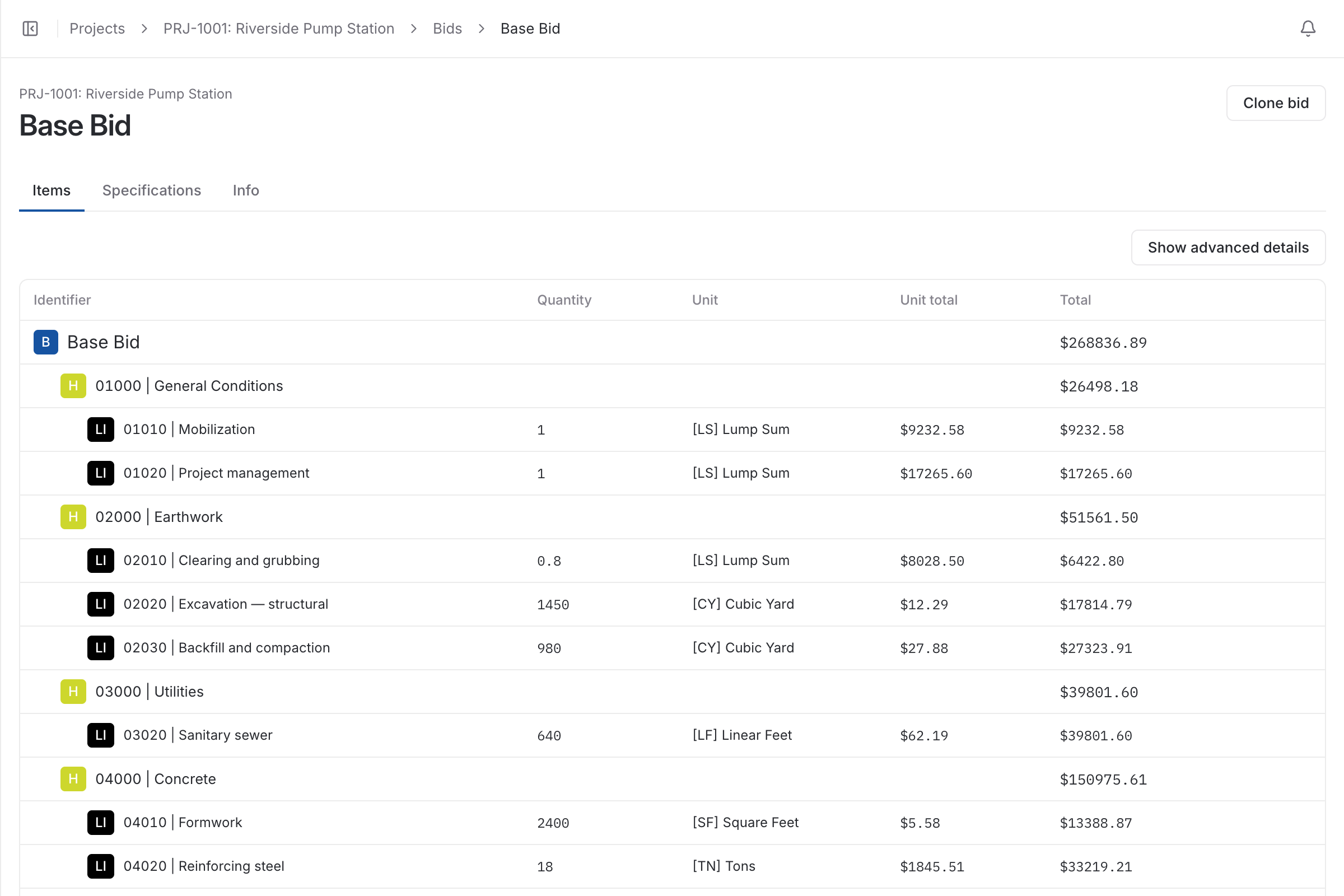
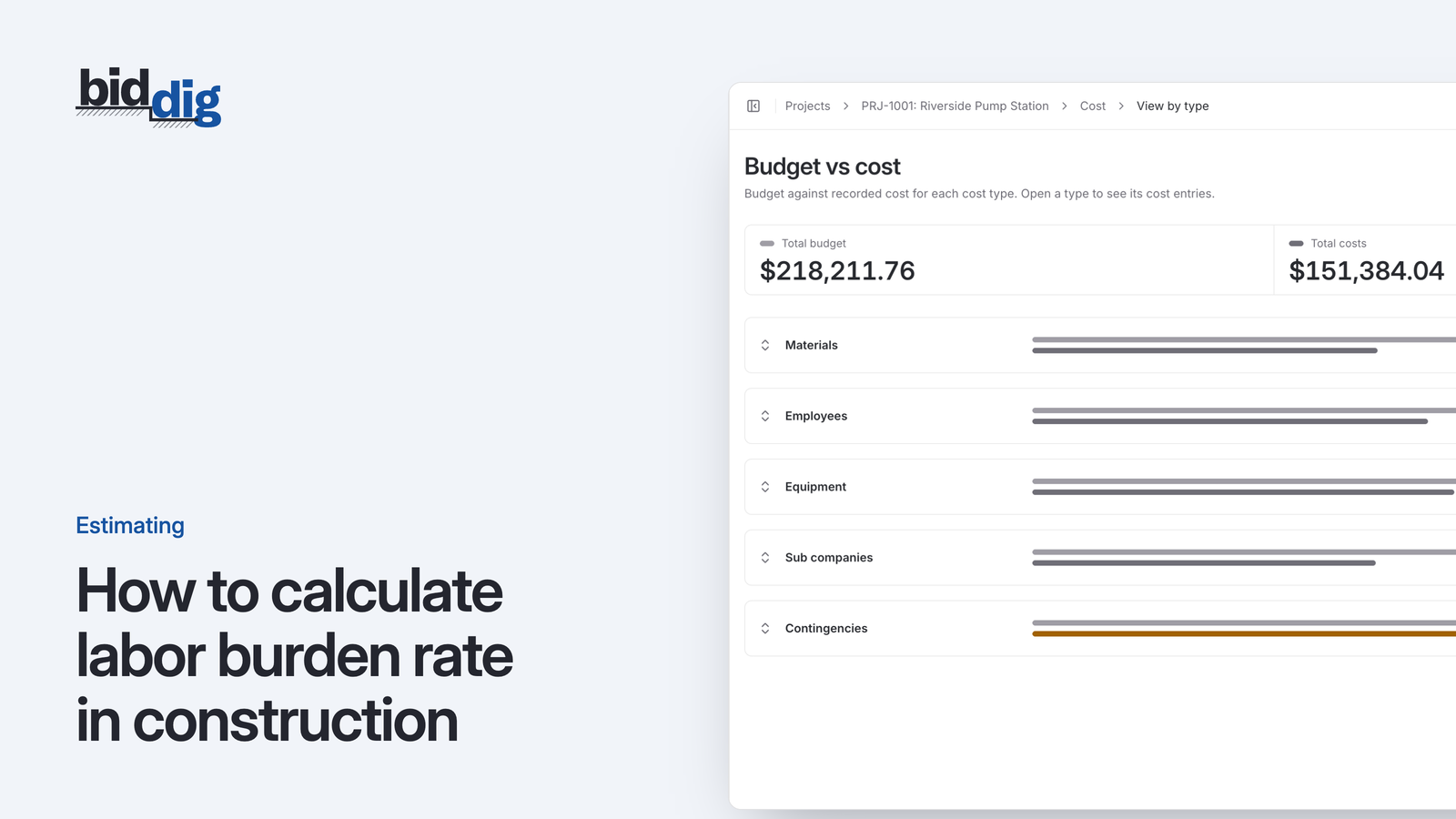
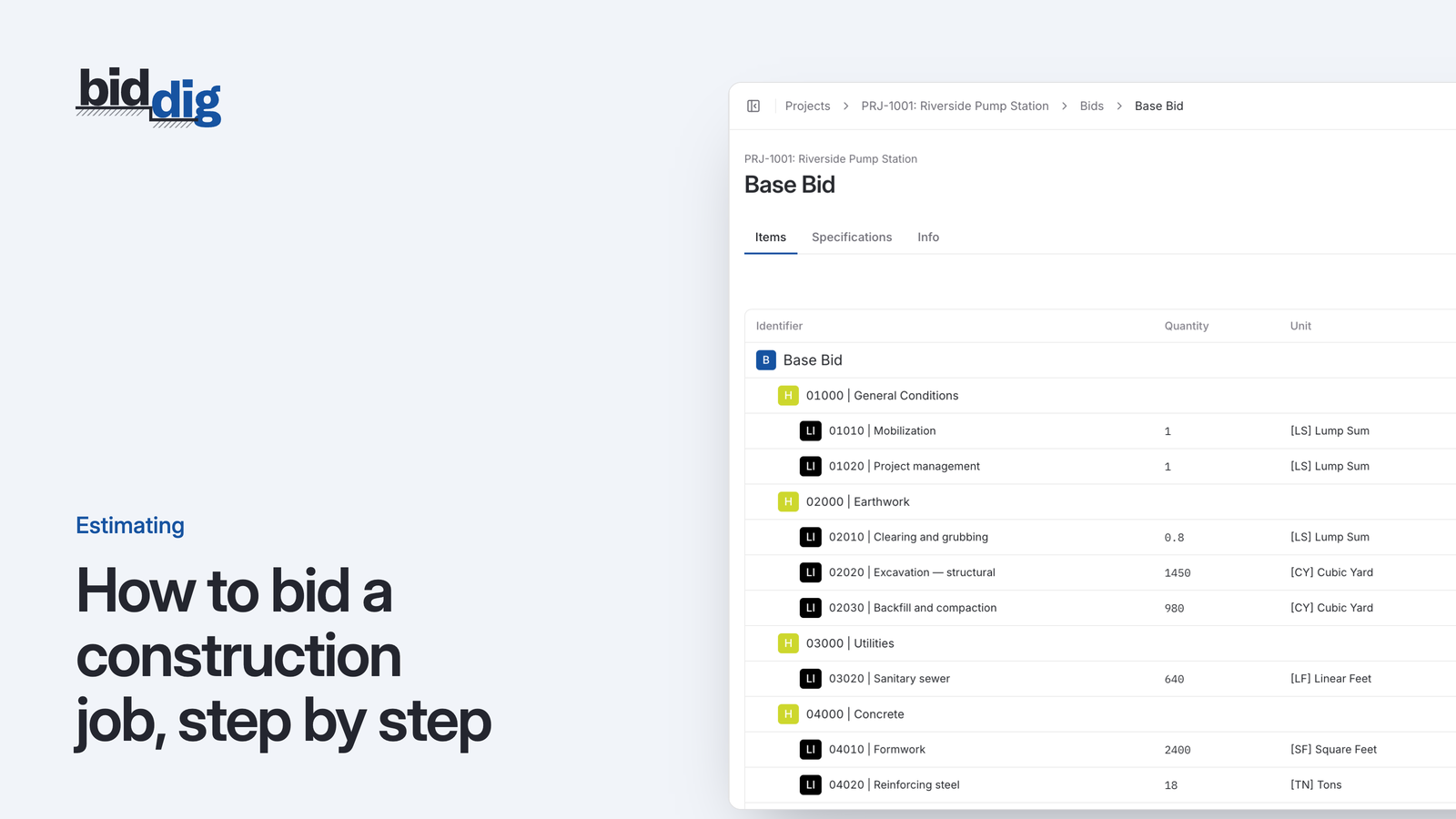
In BidDig, contingency is one of the five costs on every line item, beside material, labor, equipment and subcontractor, so the allowance stays attached to the work it protects. When a bid is awarded, its line items become the budget, and costs are recorded against each line by type, including miscellaneous and contingency. Budget vs actual is shown by cost type and by line item. See the estimating and bidding page, or read what belongs in a bid line item. For how the pieces fit together, see construction estimating software. If you are starting from scratch, read how to bid a construction job, step by step.