How to job cost salaried and hourly staff in construction
Hourly people cost a job by the hour. Salaried people cost the same whatever they do, which makes it easy to leave them out of job cost or count them twice.
By the BidDig team, , 5 min read
Hourly staff are job costed by recording their hours against a job and line item at their hourly cost. For salaried staff whose time belongs to specific jobs, divide annual cost (salary plus taxes, insurance and benefits) by the hours they work in a year to get an hourly equivalent, then charge their hours the same way. Everyone else stays in overhead.
Here is what goes wrong when the salaried half is skipped. A contractor runs two jobs at once. On paper they look alike: similar size, similar margin, both close to budget. One of them had a superintendent on site every day for four months, sorting out access, utilities and a difficult neighbor. The other more or less ran itself, with a foreman and a weekly visit.
The job cost reports cannot tell the two apart. The superintendent is on salary. His pay goes out every two weeks whatever he does, so nobody has ever booked his time to a job. The demanding job consumed most of a salary and shows none of it.
Hourly employees are easy. They work an hour, the hour is recorded, the job is charged. Salaried staff need a decision.
Should salaried staff be charged to jobs or to overhead?
For each salaried person, ask:
- Does their time belong to specific jobs? A superintendent who spends his days on site is working on particular projects. A bookkeeper is not.
- Could you realistically record it? A superintendent on two jobs can say where his week went. An owner who takes forty calls a day across twelve jobs cannot, and should not try.
If both answers are yes, the person's time is a job cost and should be charged to jobs. If either is no, the person belongs in overhead and is recovered through the overhead markup on every bid.
Either choice can be right. What matters is that the same choice is made in the bid and in job cost.
How to convert a salary to an hourly rate for job costing
To charge a salaried person to jobs, you need a cost per hour. Take the annual cost of the person and divide it by the hours they work in a year.
Here is an example with made-up figures. Say a superintendent is paid a salary of $90,000 a year, and the company's other costs for him (payroll taxes, insurance and benefits) come to $22,320 a year. Use your own figures for these.
- Annual cost: $90,000 + $22,320 = $112,320
Now the hours. There are two reasonable choices:
| Basis | Hours in the year | Hourly equivalent |
|---|---|---|
| Standard year, 52 weeks × 40 hours | 2,080 | $112,320 ÷ 2,080 = $54.00 |
| Expected working hours, 48 weeks × 45 hours | 2,160 | $112,320 ÷ 2,160 = $52.00 |
The second basis is closer to the truth for most superintendents: fewer weeks, because of vacation and holidays, and longer weeks. Use the one that matches how the person actually works, and use the hours you expect them to record. If he will book 45 hours a week, divide by a year built on 45-hour weeks. Otherwise you charge jobs for more than he costs.
Whichever you pick, write it down and hold it for the year.
How to allocate a salaried employee's time to jobs
With a rate, a salaried person's time is recorded like anyone else's: hours, by day, against a project and a line item.
Say the superintendent, at the $52 rate, works a 45-hour week:
- Job A: 25 hours × $52 = $1,300
- Job B: 15 hours × $52 = $780
- Yard, office and company meetings: 5 hours × $52 = $260
That adds up to 25 + 15 + 5 = 45 hours and $1,300 + $780 + $260 = $2,340, which is 45 × $52. The $260 was not spent on any job and stays in overhead.
A few practical points:
- Daily totals are enough. "Six hours on Job A, three on Job B" at the end of the day is the right level of detail.
- Give it a line item in the bid. If supervision will be charged to the job, the bid needs a line for it, with hours. Otherwise the cost lands on a job with no budget to meet it.
- Do not spread it by formula. Splitting a salary across jobs by revenue is quick, and it hides exactly what you wanted to see: which jobs take the most attention.
Which salaried costs stay in overhead?
Some salaried cost should never be pushed onto jobs:
- The owner's general management time. Running the company is not a cost of any one project.
- Office and accounting staff. Their work serves the whole business.
- Estimating. Time spent bidding work, most of which is not won, cannot be charged to the jobs that were.
- Unassigned time. Training, company meetings, time between projects.
A project manager is the borderline case. One who runs two large jobs can book time to them. One who touches ten small jobs in a day usually cannot do it accurately, and a rough split is worse than leaving the role in overhead and recovering it through markup.
How to avoid counting a salary in both overhead and job cost
The risk in all of this is double counting.
Overhead markup exists to recover the costs that are not charged to jobs. If the superintendent's salary is inside the overhead figure used to set that markup, and his hours are also charged to jobs as a direct cost, the customer is being asked to pay for him twice. Bids come out high and work is lost for no good reason.
The opposite mistake: the salary is taken out of overhead, but no supervision line is added to the bids. Then it is recovered nowhere.
So when you move a person from overhead to job cost, do both halves:
- Take their cost out of the overhead total that your markup is based on, and recalculate the markup.
- Add their time to bids as a direct cost on a line item.
The post on how to price overhead and profit in a construction bid explains how the markup is built. For the costs that sit on top of any wage or salary, see what an hour of labor really costs.
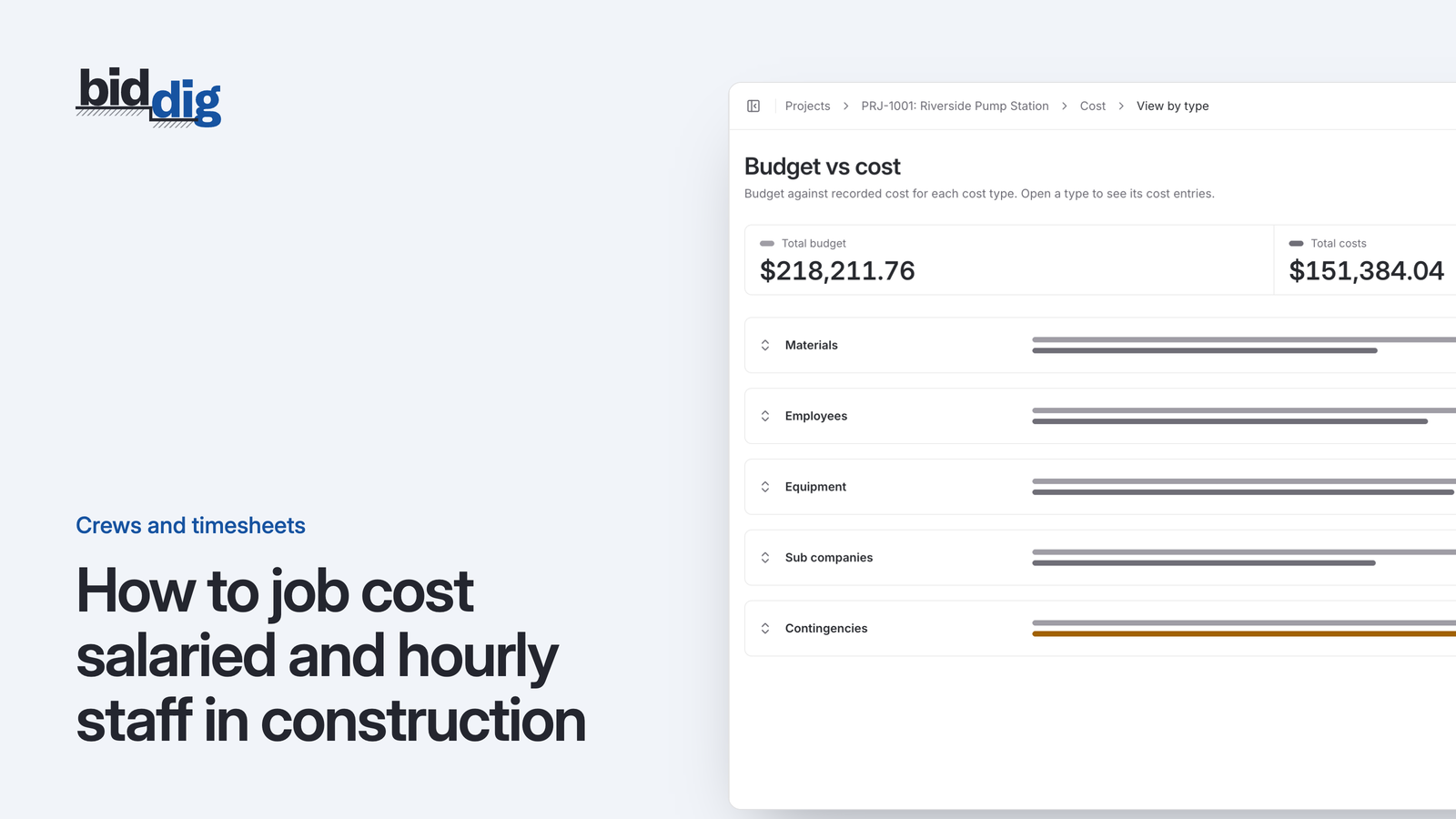
How BidDig job costs hourly and salaried staff
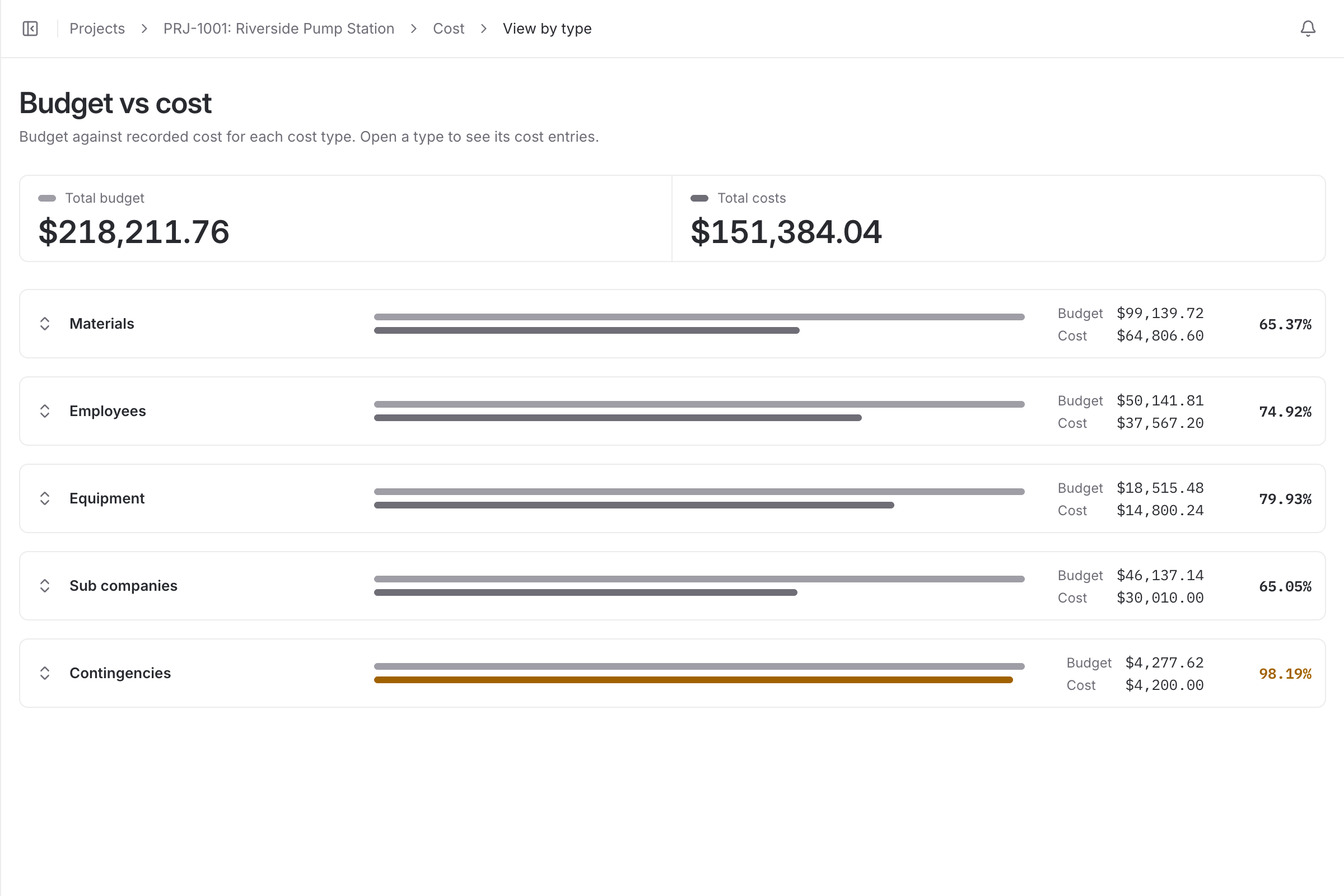
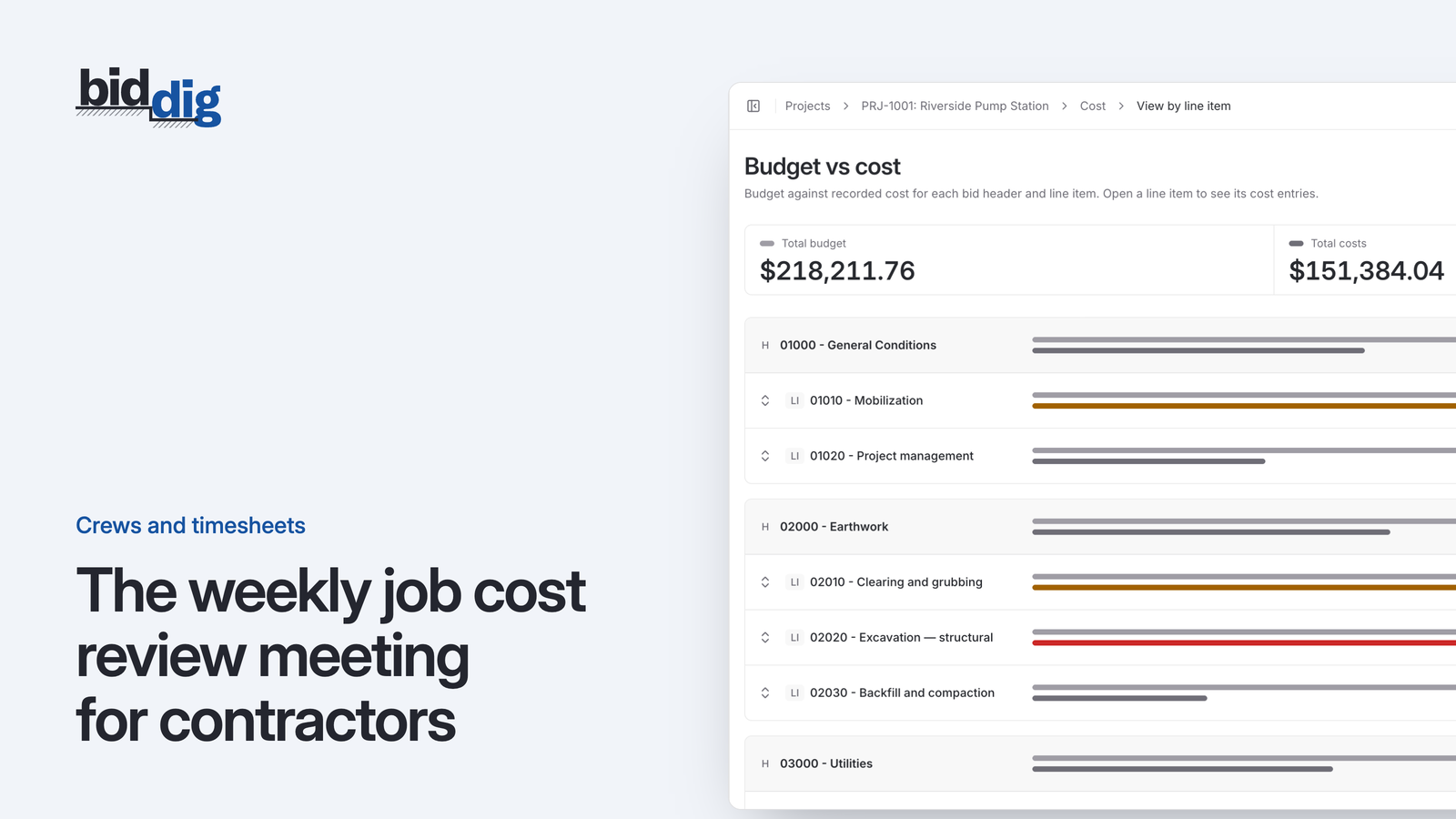
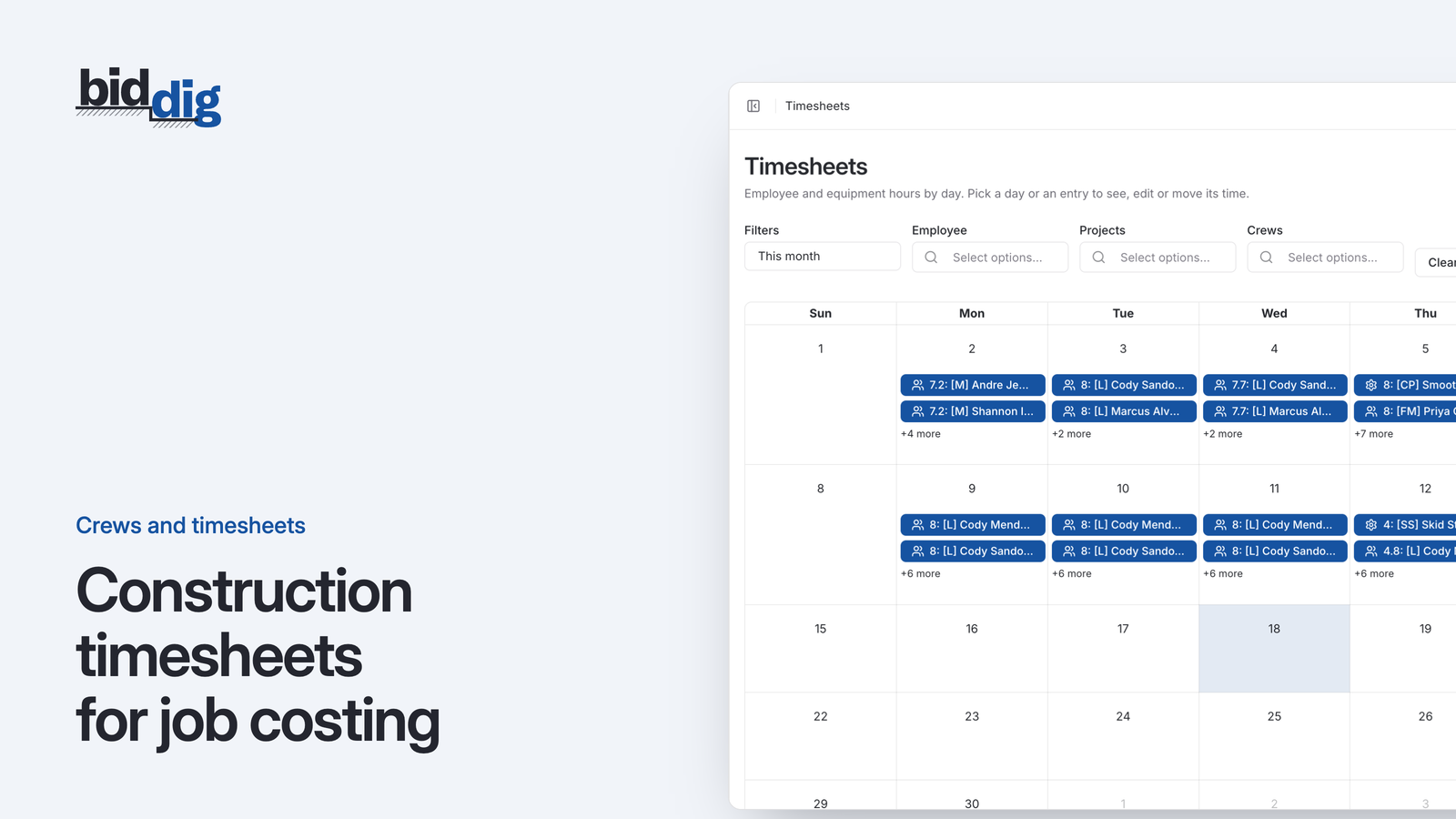
In BidDig, each employee has a classification and either an hourly or a salary rate. A salary is turned into an hourly rate over a standard year of 2,080 hours (40 hours x 52 weeks), the first basis in the table above. Hours are entered on the timesheet calendar against a project and a line item, and they are job cost when saved, so supervision can be given its own line item in the bid and tracked against it like any other labor. Budget vs actual then shows labor by cost type and by line item. See timesheets and crews, and the post on timesheets that feed job cost. For how the pieces fit together, see construction timesheet software.