How to structure a construction crew
A crew is a set of people and machines that work together under one foreman. Keeping that set stable is what lets you compare one job's costs with the next.
By the BidDig team, , 6 min read
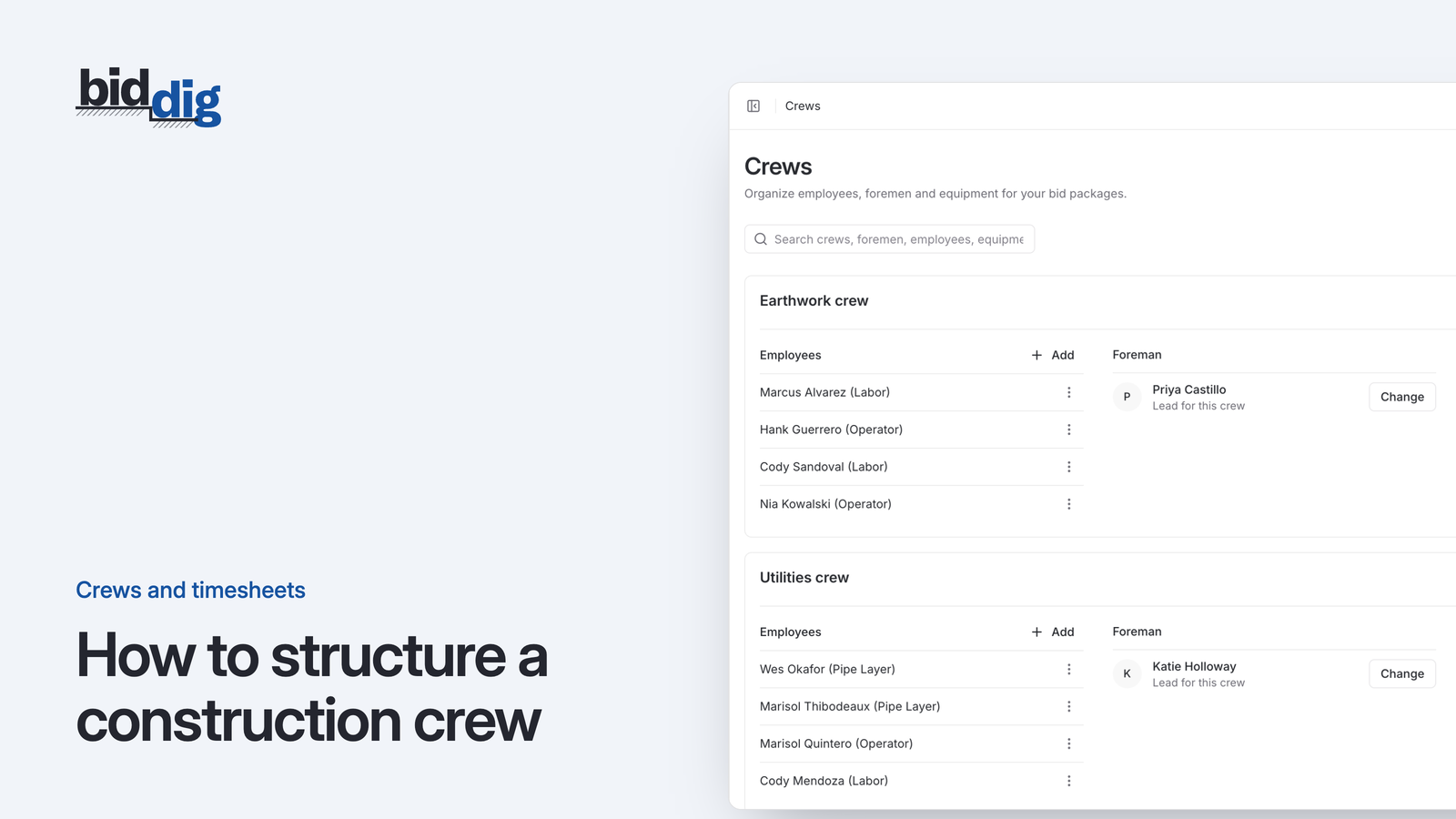
A construction crew is a fixed group of people and machines built for one type of work and led by one foreman. To structure one, define the roles, the equipment, the work it does and the single foreman who directs it and records its hours. Then keep that makeup stable, so its cost per hour and its production can be compared from job to job.
How do you set up a construction crew?
A crew is a defined group, not whoever was free that week. Four things define it:
- People, by role. Not only names but what each does: an operator, a pipe layer, two laborers. The mix of classifications sets the crew's hourly labor cost.
- Machines. The excavator and loader are as much a part of a pipe crew as the people. A crew defined without its equipment is half a crew and half a cost.
- A type of work. A crew is built for something: pipe, grading, concrete flatwork, framing.
- One foreman. One person who directs the work and answers for it.
When all four are defined, the crew has a cost per hour and, over time, a production rate. Those two numbers are what estimating runs on.
To set one up, work through it in this order.
- Start from the work you bid. List the kinds of work that appear as separate line items in your bids, such as pipe, grading and paving. Each is a candidate for a crew.
- Name the foreman. One per crew.
- List the roles the work needs. Operator, pipe layer, laborers. Decide the roles first and fill them with people second.
- Attach the machines. The equipment that normally works with those people.
- Work out the crew's cost per hour. Add the hourly cost of each person and each machine. The example below shows how.
- Write it down where the office and the field both see it. A crew that exists only in the superintendent's head changes every time he is busy.
- Record production as jobs finish. Feet a day, yards a day, whatever unit the work is bid in.
Why should each crew have only one foreman?
A crew with two people in charge has nobody in charge of the paperwork. Each assumes the other turned in the hours. Each remembers the day slightly differently.
Giving every crew exactly one foreman settles three things at once:
- Who directs the work. The crew has one source of instructions.
- Who records the hours. One person enters time for the people and machines in the crew, every day, against the line items they worked on.
- Who to ask. When a line item runs over, there is one person who was there and knows why.
If a crew is too big for one foreman to watch, it is probably two crews. Split it, give each a foreman, and let a superintendent coordinate between them.
How do you calculate crew cost per hour?
Add up the hourly cost of every person and every machine in the crew. Here is an example with made-up figures. Say a pipe crew is one foreman, one operator, one pipe layer and two laborers, with an excavator and a loader.
| Crew member | Example cost per hour |
|---|---|
| Foreman | $48 |
| Operator | $44 |
| Pipe layer | $38 |
| Laborer | $30 |
| Laborer | $30 |
| Excavator | $57 |
| Loader | $43 |
| Crew total | $290 |
- Labor: 48 + 44 + 38 + 30 + 30 = $190 an hour
- Equipment: 57 + 43 = $100 an hour
- Crew: 190 + 100 = $290 an hour
- Eight-hour day: 8 × $290 = $2,320
Divide the day's cost by the day's production to get a cost per unit:
- At 160 feet of pipe a day: $2,320 ÷ 160 = $14.50 a foot
- At 120 feet a day: $2,320 ÷ 120 = $19.33 a foot
Use the full cost of each person's hour, not the bare wage. The post on timesheets that feed job cost covers how the hours themselves are recorded.
Why does a stable crew make job costs comparable?
An estimator sits down to price 1,200 feet of storm pipe. The obvious question is how much pipe the company's pipe crew lays in a day. Too often the honest answer is that nobody knows, because the company does not really have a pipe crew.
It has a foreman who usually does pipe, with whoever was free. On the last job he had four people and one excavator. On the job before he had six people and two machines. Production was different on both, and so was the cost per foot. Neither number tells the estimator what to carry on the next bid.
Go back to the example. If the same crew laid 160 feet a day on one job and 120 on the next, the difference between $14.50 and $19.33 a foot means something. It points at the job: deeper trench, wetter ground, more traffic, bigger pipe. That is exactly what an estimator needs to know when pricing the third job.
Now suppose the second job had a different operator, an extra laborer and no loader. The cost per foot changed, but you cannot say why. It could be the ground or it could be the crew.
A stable crew turns each finished job into a data point. A crew that changes every week turns each job into a one-off.
What do you do when crew members are absent or move between crews?
No crew stays identical forever. People are out sick, a machine breaks down, a small job does not need everyone. The goal is a stable default, not a rule that never bends.
- Start from the standard crew and record the difference. If a laborer was out Tuesday, Tuesday's hours show four people. The crew definition does not change.
- Lend people, do not redefine crews. A laborer who helps the concrete crew for two days books those hours to the concrete line item. He is still a member of the pipe crew.
- Change the crew on purpose. If the crew really needs a second operator from now on, change the definition, and note when, so jobs before and after are not compared as if nothing happened.
- Keep the crew separate from the job assignment. A crew is a standing group. Which projects each person is allowed to work on and book time to is a separate question, and it changes more often.
Floating people, such as a truck driver who serves several crews, do not have to belong to a crew. Book their hours directly to the jobs and line items they served.
How many crews should a contractor have?
As many as there are kinds of work you bid as separate line items and have enough of to keep a group busy. A small contractor may have two crews. A larger one may have ten.
The test is whether each crew matches a kind of work in your bids. If you bid pipe, grading and paving as separate lines, having a pipe crew, a grading crew and a paving crew lets the cost of each crew flow to the lines it was priced against.
How BidDig handles crews
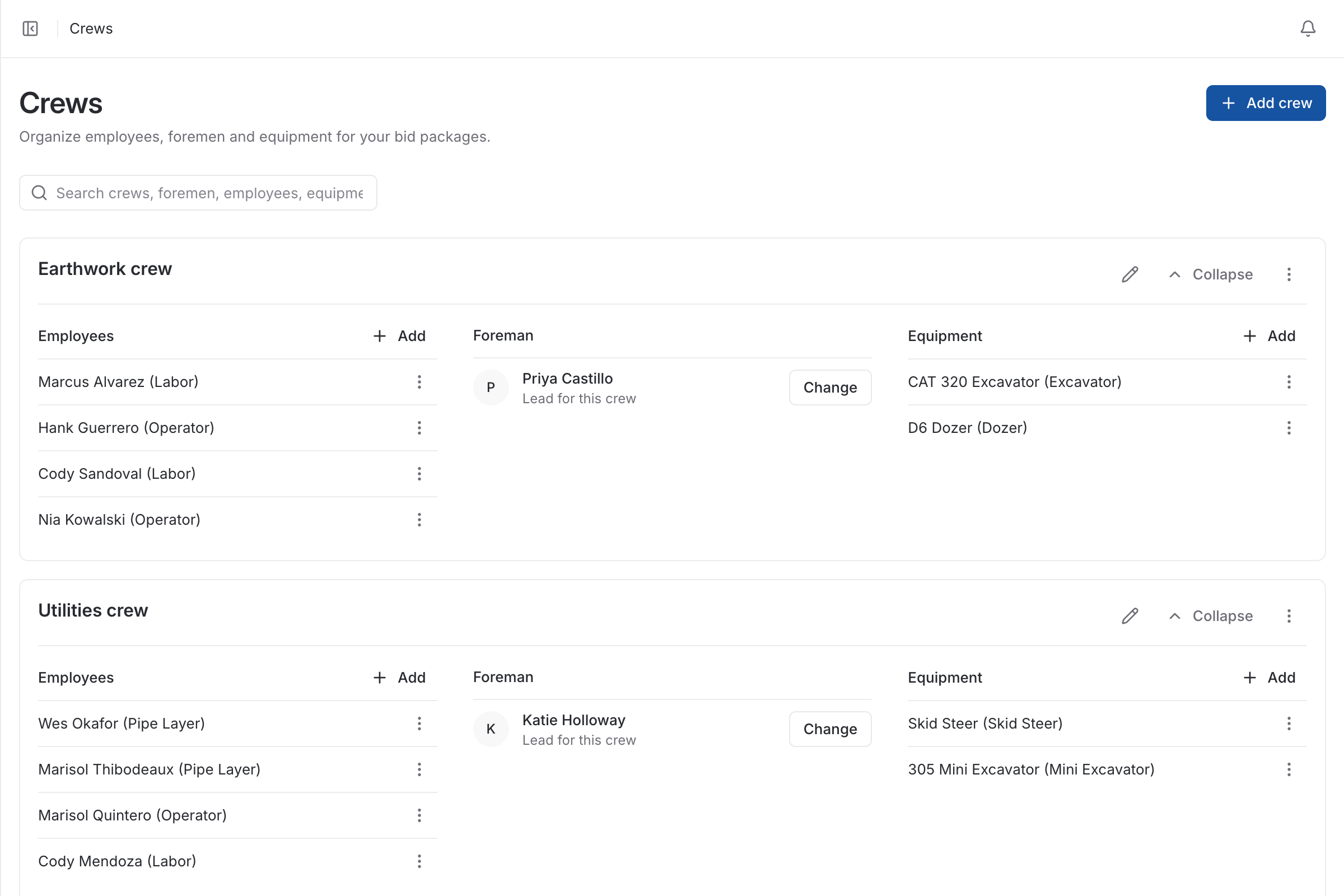
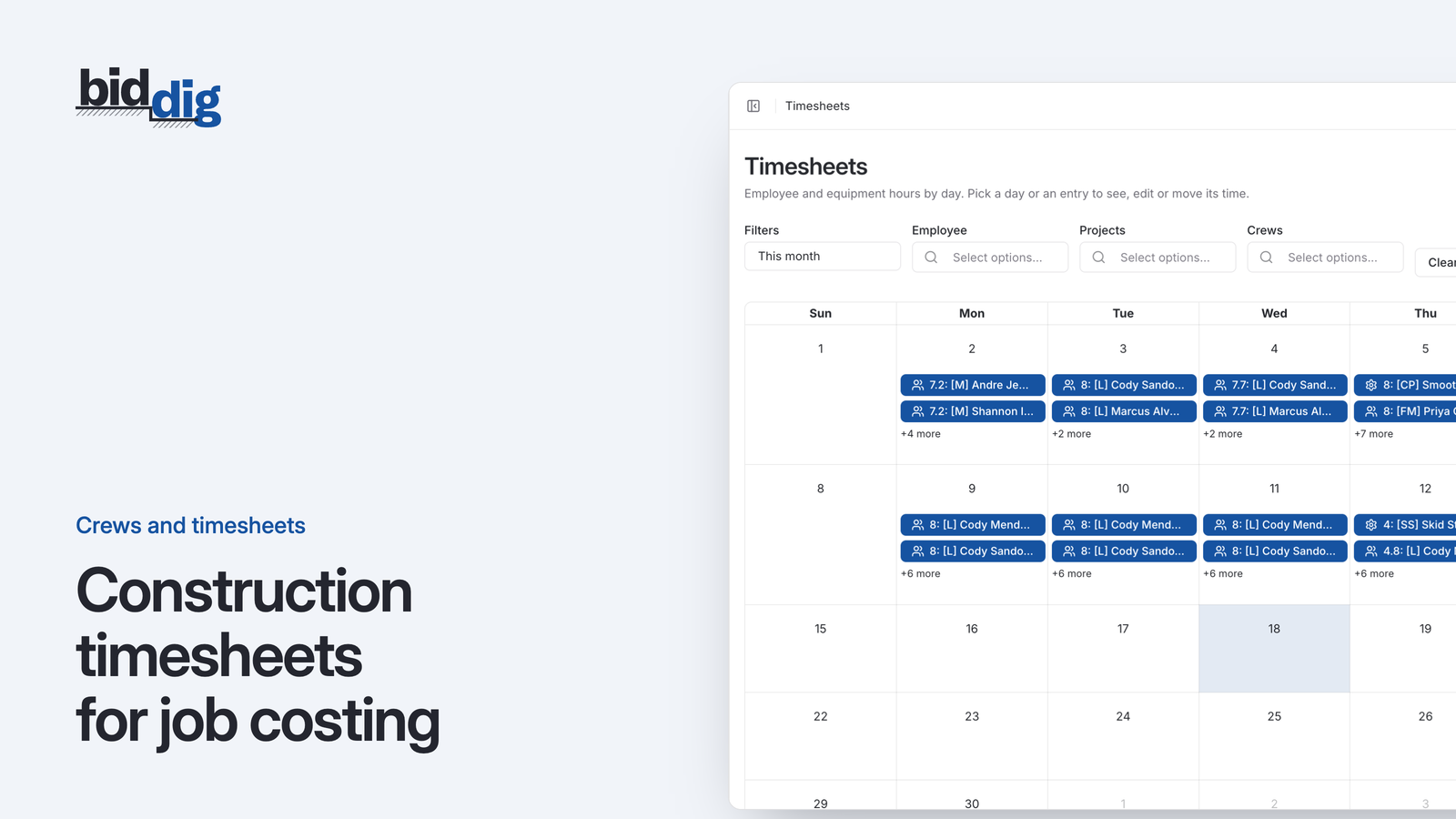
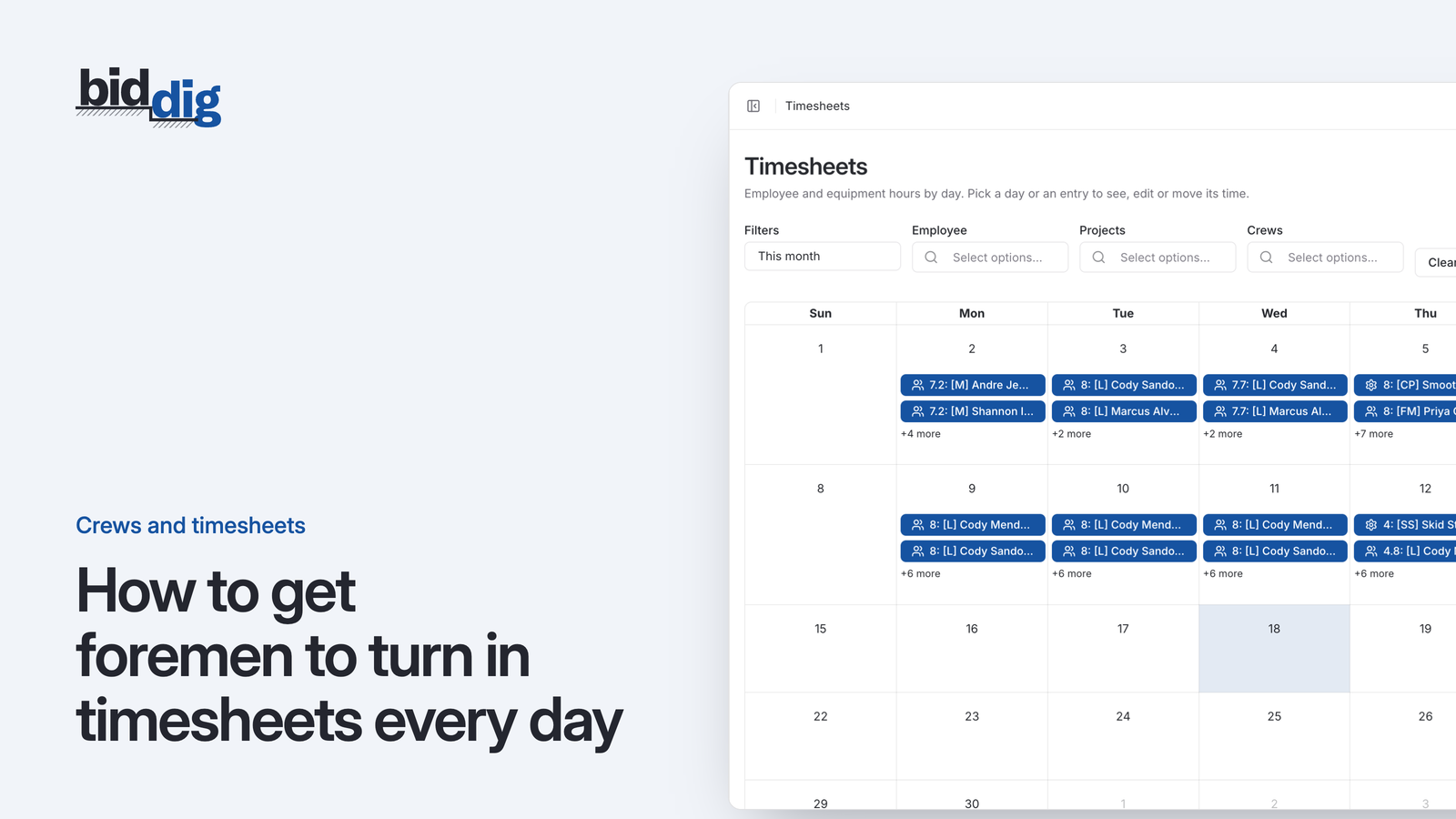
In BidDig, a crew groups employees and equipment under a foreman. Each employee has a classification and an hourly or salary rate, and people are assigned to projects individually, so crew membership and project access stay separate. The timesheet calendar can be filtered by crew, employee or project, and every entry is made against a project and line item and is job cost when saved. Superintendents can see crews.
See timesheets and crews. For how the pieces fit together, see construction timesheet software.